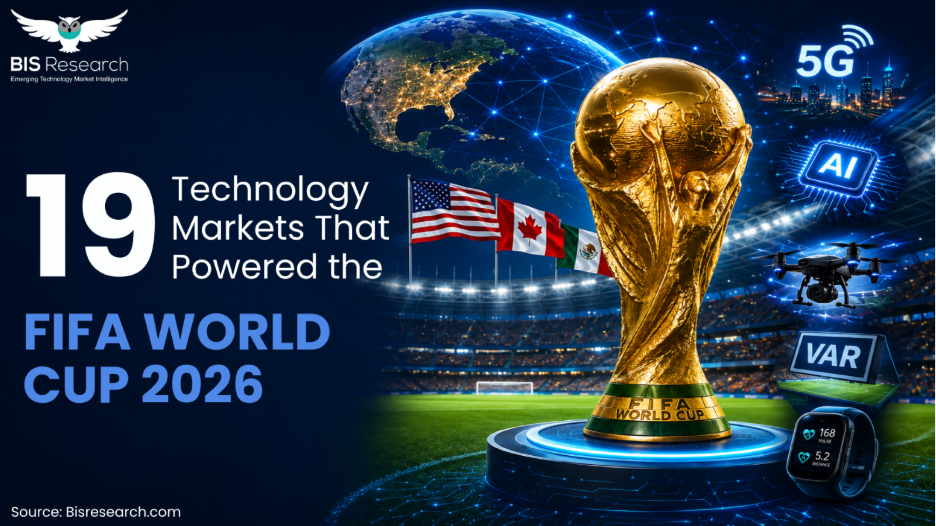
When the referee blew the first whistle at the FIFA World Cup 2026, millions of viewers saw 22 players, one ball, and a stadium filled with supporters.
What they did not see was the enormous technology ecosystem operating behind every pass, replay, offside decision, security alert, broadcast feed, fan interaction, and medical response.
Held across Canada, Mexico, and the United States, the tournament required the coordination of 104 matches across 16 stadiums. Delivering an event of this scale involved much more than preparing pitches and selling tickets. Stadium operators, telecommunications providers, broadcasters, technology companies, government agencies, security teams, and healthcare professionals had to function as parts of a connected digital system.
The FIFA World Cup 2026 therefore represented more than a football tournament. It became a large-scale demonstration of artificial intelligence, high-performance computing, advanced telecommunications, spatial technologies, immersive media, drone security, digital identity, and sports medicine.
FIFA reported that tournament and broadcast networks transported approximately 13 million gigabytes of data through around 161,000 kilometres of fibre infrastructure during the competition. The tournament also generated 20 billion video views across digital platforms by the quarter-final stage, demonstrating the scale of the infrastructure required to connect the physical event with its global audience.
Many of the technologies supporting this ecosystem connect directly or indirectly with markets covered by BIS Research.
It is important to make a distinction. Some technologies discussed below, including advanced offside systems, connected-ball technology, AI-powered match analysis, referee body cameras, 5G infrastructure, and counter-drone systems, were publicly documented in connection with the tournament. Other markets represent the underlying infrastructure and enabling technologies capable of supporting such applications, rather than confirmed FIFA deployments.
Long before players enter the pitch, stadium operators must solve one of the most difficult telecommunications challenges in the events industry.
A stadium can contain tens of thousands of spectators, thousands of staff members, television crews, security teams, match officials, connected cameras, digital displays, payment terminals, access-control systems, environmental sensors, and emergency communication devices.
All these users and machines may attempt to connect simultaneously.
The modern stadium must therefore operate more like a temporary smart city than a traditional sporting venue.
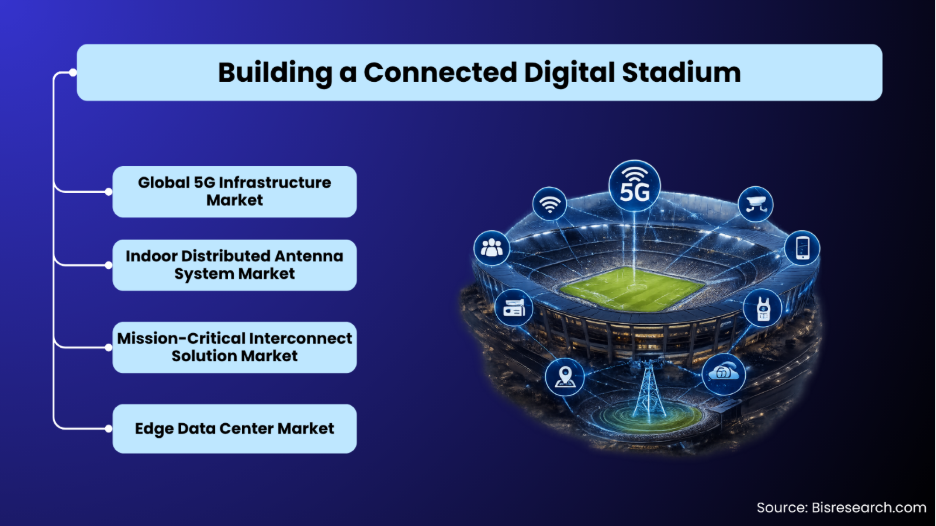
The 5G Infrastructure Market forms one of the most visible layers of the connected-stadium ecosystem.
5G networks provide the high capacity, low latency, and dense device connectivity required for data-intensive applications. During a major football match, these applications can include mobile ticketing, instant video uploads, live match statistics, digital navigation, security communications, media production, and interactive fan experiences.
The importance of 5G becomes particularly clear during peak moments. A goal, penalty, controversial decision, or final whistle can cause thousands of spectators to upload images and videos at almost the same time. Without sufficient network capacity, congestion can reduce service quality precisely when demand is highest.
Verizon, the tournament’s official telecommunications services sponsor, deployed 5G and fibre infrastructure to support stadiums, official sites, tournament operations, broadcast requirements, and fan experiences in the United States. Its World Cup infrastructure was designed to support a tournament covering 104 matches across 16 stadiums and three countries.
Private and public 5G networks can also support operational use cases. Security personnel may require prioritised communication. Broadcasters may transmit high-resolution footage wirelessly. Venue operators may monitor equipment and crowd movement in real time.
The 5G opportunity is therefore not limited to faster mobile internet. It covers the broader transformation of stadiums into intelligent, software-driven environments.
Providing outdoor network coverage is not enough inside a large stadium.
Concrete structures, metal roofing, enclosed corridors, underground areas, hospitality suites, and densely packed spectators can weaken radio signals. The Indoor Distributed Antenna System Market addresses this problem by distributing mobile signals through a network of strategically positioned antennas.
An indoor DAS can connect with multiple mobile operators and spread capacity throughout seating areas, concourses, press rooms, tunnels, retail zones, and operational spaces.
Its role becomes particularly important during high-density events because network demand is not evenly distributed. Spectators may concentrate around entrances before kickoff, move to food and retail areas at half-time, and gather around transport exits after the match.
A properly designed DAS helps maintain consistent network performance across these changing traffic patterns. It also supports public safety communications by reducing coverage gaps in areas where emergency teams may need dependable connectivity.
Every camera, antenna, sensor, server, display, and control system depends on physical and electronic connections.
The Mission-Critical Interconnect Solution Market covers high-reliability connectors, cables, fibre assemblies, switches, and related components used in environments where communication failures can disrupt essential operations.
Within a stadium, these solutions may connect broadcast cameras with production systems, antennas with network equipment, security sensors with command centres, and data-processing hardware with storage infrastructure.
Ordinary consumer-grade connectivity is not sufficient for these environments. Interconnect systems must withstand repeated installation, vibration, temperature variation, physical stress, electromagnetic interference, and exposure to dust or moisture.
Their importance is easy to overlook because interconnect components remain hidden behind walls, under floors, inside racks, and within broadcasting equipment. However, even the most advanced AI platform becomes ineffective if the physical connection carrying its data fails.
Sending every piece of stadium data to a distant hyperscale data center can create unnecessary latency.
The Edge Data Center Market addresses this limitation by placing computing and storage resources closer to the point where information is generated.
At a football stadium, edge infrastructure can process security footage, crowd information, ticketing data, connected-device signals, and video feeds locally. This reduces the time required to analyse information and lowers the volume of raw data that must travel across long-distance networks.
For example, a video analytics system looking for congestion near an exit may need to detect the problem within seconds. Sending high-resolution footage to a remote facility, waiting for processing, and receiving the result may introduce avoidable delays.
Edge data centers can also improve operational resilience. Selected functions may continue running locally if a wider network connection becomes unstable.
The result is a distributed computing architecture in which stadium edge facilities, regional data centers, cloud platforms, and broadcast hubs work together.
Once the game begins, the technology focus shifts from stadium access and connectivity to events taking place on the pitch.
The 2026 tournament introduced advanced semi-automated offside technology, AI-supported match analysis, realistic 3D player avatars, stabilised referee body-camera footage, and connected-ball data.
FIFA and Lenovo developed Football AI Pro to provide analysis capabilities to all 48 participating teams. The technology ecosystem also supported 3D recreations and more realistic offside visualisations using digital scans of the tournament’s 1,248 players.
These applications depended on a considerable computing foundation.
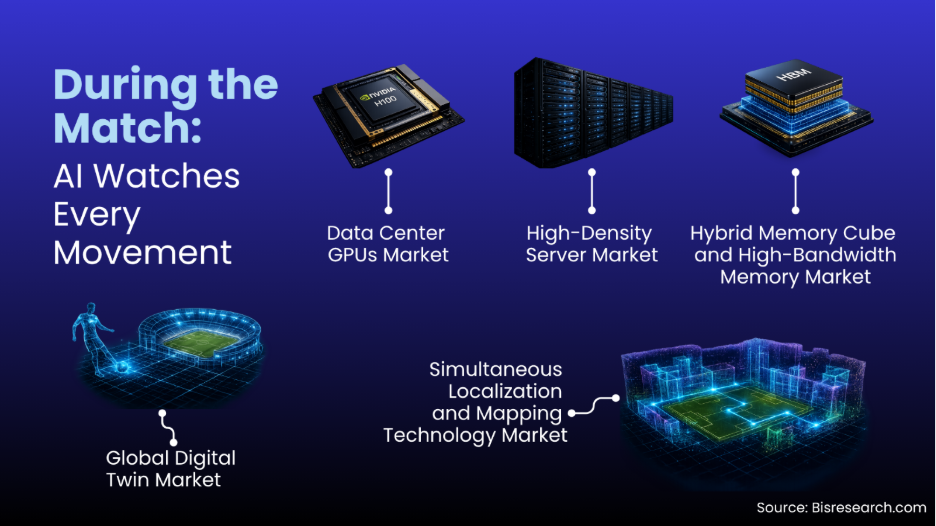
The Data Center GPUs Market is one of the most important enabling markets behind modern AI and visual computing.
Graphics processing units were originally designed to process images and computer graphics, but their parallel architecture makes them well suited to artificial intelligence, computer vision, simulation, and video analytics.
Football technology can generate data from multiple camera feeds, player-tracking systems, ball sensors, body cameras, and event databases. GPUs help process this information quickly enough to support practical decisions and visualisations.
In semi-automated offside systems, computer vision must identify player positions, analyse body points, establish the moment the ball was played, and help generate a visual representation for officials and viewers.
Connected-ball technology adds another data source. The official match ball contained a sensor capable of providing real-time information about ball movement and position. It could also identify the precise moment of contact, supporting more accurate officiating decisions.
GPU infrastructure also supports post-match analysis, automated highlight creation, tactical pattern identification, digital content generation, and large-scale video processing.
The relevance of GPUs therefore extends beyond refereeing. They form part of the computational engine through which football footage becomes structured intelligence.
GPUs must be installed within systems capable of supplying sufficient power, networking, storage, and cooling.
The High-Density Server Market covers server platforms that place significant computing capacity within a limited physical footprint.
This density is important for tournament technology because video and AI workloads can require multiple accelerators operating in parallel. Central broadcast facilities, regional processing hubs, and cloud environments must be capable of handling simultaneous live feeds and analytical workloads.
High-density servers can support video encoding, AI inference, image rendering, tactical analysis, content distribution, and data storage.
However, increasing server density creates additional engineering challenges. More computing power within each rack produces more heat, increases power consumption, and places greater pressure on cooling systems.
For major sporting events, operators must balance computational performance with reliability. A system that performs well during testing but overheats under peak matchday demand is not suitable for mission-critical deployment.
Processing power alone does not determine AI performance. Data must move between memory and processors quickly enough to keep the computing units productive.
The Hybrid Memory Cube and High-Bandwidth Memory Market addresses this requirement.
High-bandwidth memory places multiple memory layers close to the processor and enables large quantities of data to be transferred rapidly. This is particularly valuable for AI accelerators and advanced graphics systems processing high-resolution video, complex models, or three-dimensional environments.
In a football analytics context, systems may need to compare numerous frames from multiple cameras while evaluating player positions, ball movement, and spatial relationships.
Memory bandwidth can become a bottleneck if the processor spends too much time waiting for data. High-bandwidth memory reduces this limitation, helping AI systems maintain faster analytical performance.
The market therefore represents a critical but less visible layer of the AI infrastructure stack.
The Digital Twin Market provides a useful framework for understanding how physical football activity can be recreated digitally.
A digital twin is a virtual representation of a real object, system, or environment that can be updated using data from the physical world.
Within football, elements of this concept can be applied to players, the ball, the pitch, stadium systems, and match situations. Tracking information and camera data can be combined to reproduce an event from different angles, even when no physical camera occupied the selected viewpoint.
FIFA’s 3D player recreations and realistic avatars demonstrate how digital representations can improve the communication of complex decisions. Rather than showing viewers only lines drawn over a video frame, a three-dimensional reconstruction can explain an offside situation more clearly.
Beyond officiating, digital stadium models can support crowd planning, evacuation simulations, maintenance, energy management, broadcast-camera positioning, and security exercises.
The digital twin opportunity therefore extends from match analysis to the operation of the entire venue.
The Simultaneous Localization and Mapping Technology Market, commonly known as SLAM, concerns technologies that allow a system to determine its position while constructing or updating a map of its surroundings.
SLAM is commonly associated with autonomous vehicles, robots, drones, and augmented reality. Its connection with football lies in spatial understanding.
Systems working in a three-dimensional stadium environment must interpret location, depth, movement, and the relationship between physical objects. Similar spatial-computing principles can support camera positioning, virtual scene creation, mobile robots, indoor navigation, and augmented-reality experiences.
SLAM should not be confused with conventional football tracking. Optical player-tracking systems may rely on calibrated camera networks and specialised algorithms rather than a traditional SLAM architecture.
However, both markets address the broader challenge of converting movement within a physical space into an accurate digital coordinate system.
For most supporters, the World Cup is experienced through a television, mobile phone, streaming platform, social network, or digital news service.
The broadcast challenge is therefore as significant as the match itself.
The International Broadcast Centre in Dallas acted as the central hub for media operations and global content distribution. FIFA stated that the broadcast ecosystem supported advanced live match coverage alongside approximately 8,000 hours of additional non-live content.
Moving this volume of content required terrestrial networks, fibre infrastructure, data centers, cloud platforms, satellites, and production technologies to operate together.
The High-Throughput Satellite Market remains relevant even as fibre networks and internet-based broadcasting expand.
High-throughput satellites provide greater communication capacity than traditional satellite systems by using multiple focused spot beams and frequency-reuse technologies.
For international sporting events, satellite connectivity can support live contribution feeds, connectivity in temporary locations, backup communication paths, and content distribution to regions with limited terrestrial infrastructure.
Redundancy is particularly important. A single network failure should not interrupt a match being watched across multiple countries.
Satellite and terrestrial systems therefore complement each other. Fibre may carry large volumes of primary traffic, while satellite connections provide flexibility, geographical reach, and alternative transmission routes.
The Global Augmented Reality and Mixed Reality Market connects the physical match with digital layers of information.
Augmented reality can place player statistics, tactical diagrams, ball trajectories, offside lines, and sponsor content over live footage. Mixed-reality systems can create more interactive environments in which digital objects appear to occupy physical space.
For broadcasters, these technologies make complex data easier to understand. A tactical pattern can be displayed directly over the pitch. A reconstructed play can be examined from different angles. A studio presenter can interact with a three-dimensional visualisation of the match.
For supporters, AR can support venue navigation, interactive ticketing, digital merchandise, player information, gamified content, and remote stadium experiences.
The long-term opportunity is the development of personalised broadcasts. Different viewers could choose the statistics, camera angles, commentary layers, and visual information most relevant to them.
Managing a tournament of this scale requires the verification of players, officials, employees, contractors, media representatives, volunteers, and visitors.
The Biometric Authentication and Identification Market covers facial recognition, fingerprint recognition, iris scanning, voice identification, and related identity-verification technologies.
Biometric systems can support secure-zone access, credential verification, border processing, and contactless passenger journeys. However, their deployment requires careful attention to privacy, consent, cybersecurity, accuracy, bias, and data-retention policies.
The market’s relevance to the World Cup extends beyond stadium gates. The tournament created major cross-border travel requirements across three host countries. U.S. Customs and Border Protection used advanced travel-processing and security tools to manage international visitor flows, while biometric facial-comparison systems already formed part of the broader U.S. border-processing environment.
The central challenge is balancing security with convenience. Identity checks must be robust enough to prevent unauthorised access without creating excessive queues or unnecessary friction.
The airspace surrounding major sporting venues has become an important part of event security.
Commercial drones are affordable, widely available, and capable of carrying cameras or other payloads. While authorised drones may support broadcasting, inspection, mapping, or public safety, unauthorised aircraft can create collision risks, interrupt operations, invade privacy, or present security threats.
The FAA established temporary flight restrictions and “No Drone Zones” around World Cup stadiums, fan events, and related locations in the United States. The Department of Homeland Security also supported the positioning of drone sensors and the deployment of counter-UAS strategies around designated restricted areas.
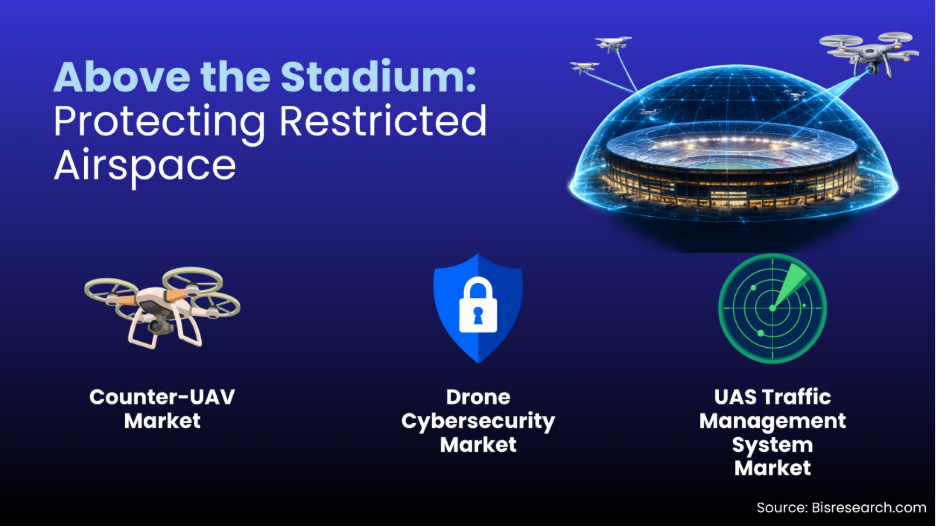
The Counter-UAV Market includes technologies used to detect, identify, track, classify, and, where legally authorised, mitigate unmanned aircraft.
Detection technologies may include radar, radio-frequency sensors, acoustic systems, electro-optical cameras, infrared cameras, and multi-sensor platforms.
No single sensor performs perfectly in every environment. Stadiums contain buildings, vehicles, communication signals, moving crowds, and other sources of interference. Counter-UAV platforms therefore combine data from multiple sensors to distinguish a suspicious drone from birds, aircraft, or authorised operations.
The U.S. government placed considerable emphasis on counter-drone readiness for the tournament. FEMA awarded $250 million through a counter-UAS grant programme to U.S. World Cup host states and the National Capital Region.
A drone is not only an aircraft. It is also a connected computing system.
The Drone Cybersecurity Market focuses on protecting communication links, navigation signals, onboard software, sensors, data storage, ground-control systems, and cloud platforms.
Potential threats include signal jamming, navigation spoofing, unauthorised control, malicious software, data interception, and manipulation of command links.
Cybersecurity is also important for authorised drones. A security or broadcast drone could itself become a vulnerability if attackers gained access to its video feed, location data, or control interface.
Effective drone security therefore requires encrypted communications, secure identity management, software updates, hardware protection, anomaly detection, and resilient navigation capabilities.
Counter-drone systems focus on threats, while the UAS Traffic Management System Market addresses the coordination of legitimate unmanned aircraft.
A UAS traffic management platform can support flight authorisation, geofencing, digital identification, route coordination, restricted-zone enforcement, and real-time airspace awareness.
This is important because simply banning every drone may not be practical. Broadcasters, police departments, emergency responders, infrastructure inspectors, and venue operators may have valid reasons to operate authorised aircraft.
The challenge is to distinguish these approved flights from unauthorised activity quickly and accurately.
UAS traffic management systems can provide the digital coordination layer connecting operators, regulators, airspace authorities, and security organisations.
Technology at the World Cup was not limited to refereeing, connectivity, and broadcasting.
Football places significant physical demands on players. Athletes repeatedly accelerate, decelerate, change direction, jump, collide, and perform at high intensity, often under demanding environmental and scheduling conditions.
Medical teams must identify injuries quickly, determine whether a player can continue safely, manage recovery, and reduce the risk of further harm.
FIFA maintains medical standards and research programmes intended to improve player health, clinical care, and football medicine. Its quality programme for Electronic Performance and Tracking Systems also evaluates wearable and optical tracking technologies, including performance and safety criteria.
The Biosensors Market covers devices that convert biological or physiological information into measurable signals.
In sport, biosensors can monitor heart rate, movement, temperature, hydration indicators, blood oxygen, sweat composition, glucose-related parameters, and other physiological signals.
Wearable sensors can help performance teams understand training load, recovery, fatigue, and exertion. Point-of-care biosensors may support rapid medical assessments when immediate information is required.
However, sensor data must be interpreted carefully. A single measurement does not automatically provide a diagnosis. Accuracy can be influenced by device placement, sweat, movement, environmental conditions, and individual physiology.
The greater opportunity lies in combining multiple data sources over time. Physiological information, workload data, injury history, sleep patterns, and clinical assessments can collectively provide a more complete picture of athlete readiness.
Cuts, abrasions, turf burns, and minor lacerations are common in contact sports.
The Wound Cleanser Products Market supports the first stage of wound management by helping remove dirt, blood, debris, and microorganisms from the affected area.
Prompt wound cleaning can reduce contamination and prepare the injury for dressing or further treatment. Products may include saline solutions, antiseptic cleansers, sprays, irrigation systems, and specialised formulations.
Although wound cleansers are less technologically dramatic than AI or connected-ball systems, they are part of the essential medical infrastructure surrounding every professional match.
Their inclusion illustrates an important point: the technology ecosystem of a major sporting event includes both advanced digital platforms and practical clinical products required for immediate care.
More serious injuries may require MRI, CT, ultrasound, or X-ray examinations.
The AI-Enabled Medical Imaging Solutions Market applies machine learning and computer vision to the acquisition, interpretation, prioritisation, and management of medical images.
In football, imaging may be used to assess fractures, muscle tears, ligament injuries, tendon damage, joint problems, and neurological concerns.
AI tools can assist clinicians by identifying suspicious regions, comparing scans, improving image reconstruction, prioritising urgent cases, and supporting quantitative measurements.
These tools do not replace radiologists or sports medicine specialists. Their value lies in helping medical professionals manage information more efficiently and consistently.
For elite athletes, faster and more precise imaging assessments can influence treatment choices, rehabilitation plans, and return-to-play decisions.
The Advanced Therapeutics: Aging and Wellness Market may initially appear distant from a football tournament, but its connection becomes clearer when athlete recovery and long-term health are considered.
Elite players are increasingly supported by personalised nutrition, metabolic monitoring, regenerative medicine research, muscle-preservation strategies, sleep optimisation, rehabilitation technologies, and individualised recovery programmes.
Some products and therapies associated with the wider wellness market remain experimental or require further clinical validation. Sports organisations must distinguish evidence-based interventions from unproven performance claims.
Nevertheless, the broader market reflects a significant transition. Athlete care is moving from reactive injury treatment toward continuous health optimisation.
The objective is no longer simply to return an injured player to competition. It is to maintain performance, reduce avoidable injury risks, support recovery, and protect long-term physical and neurological health.
When the final whistle was blown, the score captured only the visible result.
Behind every World Cup moment stood a network of processors, antennas, servers, sensors, cameras, satellites, security platforms, medical devices, data centers, and communication systems.
5G and indoor antenna networks kept stadiums connected. Edge infrastructure processed information close to the venue. GPUs, high-density servers, and advanced memory systems powered AI and visual computing. Digital representations helped explain match events. Satellites and fibre networks carried content around the world. AR and mixed reality transformed how viewers understood the game.
Above the stadium, counter-UAV technologies and airspace-management systems protected restricted areas. On the pitch, biosensors, wound-care products, medical imaging, and advanced recovery solutions supported player health.
The FIFA World Cup 2026 demonstrated that the future of football will not be shaped by athletic performance alone.
It will also be shaped by the technology markets operating silently behind the match. As stadiums become more connected, broadcasts become more immersive, security becomes more intelligent, and athlete care becomes more personalised, the boundary between sport and technology will continue to disappear.
The next generation of football will not simply be watched.
It will be measured, processed, reconstructed, secured, distributed, and experienced through an increasingly sophisticated digital ecosystem.