
The nucleic acid sample preparation instruments market is becoming one of the most important enablers of modern molecular testing. Whether a lab is running PCR, next-generation sequencing, liquid biopsy, infectious disease testing, oncology panels, or genomics research, the quality of DNA and RNA extraction often determines the quality of the final result. As testing volumes rise and laboratories face pressure to deliver faster, cleaner, and more reproducible outputs, sample preparation is shifting from a manual lab step to a strategic automation layer.
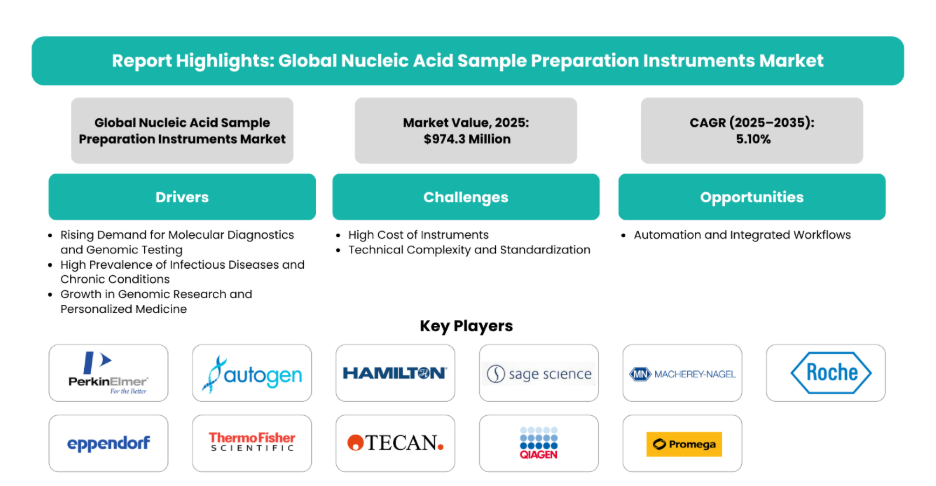
The nucleic acid sample preparation instruments market, with 2024 as the base year, is estimated at $974.3 million in 2025 and projected to reach $1,601.8 million by 2035, growing at a CAGR of 5.10% from 2025 to 2035. This growth is driven by rising demand for automated DNA/RNA extraction, molecular diagnostics, NGS, genomics research, and liquid biopsy workflows.
Request a sample report now on Nucleic Acid Sample Preparation Instruments Market
Automation is the strongest trend reshaping nucleic acid extraction instruments. Manual extraction is time-consuming, operator-dependent, and prone to variation. Automated systems reduce hands-on time, standardize protocols, and support walk-away workflows where technicians can load samples, reagents, and consumables, then let the instrument complete the process. This is especially valuable for clinical laboratories, molecular diagnostics companies, and sequencing centers handling large sample batches. Recent research also shows growing interest in automated workflows that combine extraction and library preparation to reduce human intervention in complex genomic workflows.
Magnetic bead-based nucleic acid extraction is becoming central to automated sample preparation because it is fast, scalable, and compatible with robotic platforms. Magnetic beads bind DNA or RNA, allowing impurities to be washed away while magnets separate the nucleic acids from the sample matrix. This approach supports automation better than many traditional column-based methods. NEB notes that magnetic beads offer automation compatibility and simplify nucleic acid purification workflows. Scientific research has also highlighted rapid magnetic silica bead-based methods that can improve extraction speed and efficiency.
Explore more about this market
The rise of high-throughput molecular diagnostics is expanding demand for reliable sample preparation instruments. COVID-19 exposed the limitations of manual workflows, but the broader shift is now being driven by respiratory panels, sexually transmitted infection testing, antimicrobial resistance testing, oncology diagnostics, and genetic screening. Labs need platforms that can process dozens or hundreds of samples per run with consistent yield and minimal contamination risk. Market reports consistently identify molecular diagnostics and clinical testing as major growth drivers for automated nucleic acid extraction systems.
NGS sample preparation requires high-quality nucleic acids, accurate quantification, and reproducible library preparation. As next-generation sequencing moves deeper into oncology, rare disease research, infectious disease surveillance, reproductive health and population genomics, sample prep instruments are becoming more specialized. Labs now look for platforms that can handle low-input samples, support multiple sample types, and integrate with downstream sequencing workflows. Automation in NGS library preparation is also being explored as a way to make sequencing more routine in clinical applications, including cancer management.
Liquid biopsy sample preparation is one of the most promising growth areas in the nucleic acid sample preparation instruments market. Liquid biopsy depends on extracting cell-free DNA, cell-free RNA, circulating tumor DNA, and other rare analytes from blood or plasma. These molecules are often present in very low quantities, so extraction efficiency is critical. Thermo Fisher describes liquid biopsy as a noninvasive approach for biomarker discovery, tumor monitoring, and recurrence detection. Recent studies also emphasize that optimized pre-analytical steps are essential for accurate cfDNA interpretation.
Microfluidic nucleic acid extraction systems are gaining attention because they can reduce reagent consumption, shorten turnaround time, and enable compact device formats. These systems are especially relevant for point-of-care testing, decentralized diagnostics, field testing, and low-volume genomics workflows. Miniaturized platforms can bring molecular testing closer to patients, farms, environmental monitoring sites, and remote healthcare centers. Research into lab-on-a-chip workflows suggests that miniaturized and automated systems could help move advanced sequencing and molecular diagnostics beyond centralized laboratories.
Cost-effective automated nucleic acid sample preparation instruments are becoming essential in emerging markets. Hospitals, public health labs, academic institutes, and regional diagnostic chains in Asia-Pacific, Latin America, the Middle East, and Africa need systems that balance affordability with reliability. Vendors that offer flexible throughput, lower reagent lock-in, compact footprints, and easy maintenance will be better positioned in these markets. The opportunity is not just premium automation, but practical automation that improves access to molecular diagnostics.
Download the complete TOC now!
The future of the nucleic acid sample preparation instruments market will be shaped by automation, magnetic bead extraction, NGS, liquid biopsy, microfluidics, and affordable platforms for decentralized testing. As molecular diagnostics becomes more routine, sample preparation will no longer be viewed as a back-end lab process. It will be the foundation for faster, cleaner, and more scalable DNA and RNA testing.