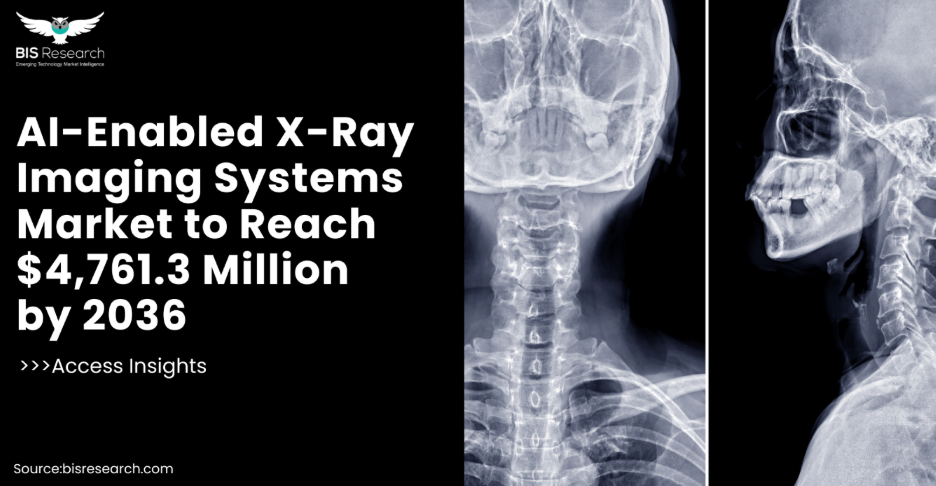
AI-enabled X-ray imaging systems are advanced radiography platforms that integrate artificial intelligence and machine learning capabilities directly into imaging hardware. These systems automate critical imaging functions such as patient positioning, exposure parameter selection, image enhancement, dose optimization, and quality assurance to improve diagnostic consistency and operational efficiency.
As healthcare providers face growing diagnostic workloads, workforce shortages, and increasing demand for rapid imaging services, AI-enabled X-ray systems are becoming essential tools in modern healthcare environments. These intelligent systems help reduce operator dependency, improve image quality, minimize repeat scans, and streamline workflows across emergency departments, intensive care units, outpatient clinics, and point-of-care settings.
According to BIS Research, the global AI-enabled X-ray imaging systems market was valued at $745.0 million in 2025 and is projected to reach $4,761.3 million by 2036, growing at a CAGR of 18.42% during the forecast period from 2026 to 2036.
Download the complete TOC and Request Sample Report
Key Drivers:
• Growing demand for efficient, standardized, and high-quality diagnostic imaging workflows
• Increasing adoption of AI-guided positioning, exposure optimization, and automated image enhancement
• Rising need to address human limitations and variability in X-ray image interpretation
• Expansion of mobile and portable X-ray systems for point-of-care and decentralized healthcare settings
• Growing focus on workflow automation, operational efficiency, and reduced operator dependency
• Increasing investments in next-generation diagnostic imaging infrastructure
According to Senior Research Analyst at BIS Research:
"The evolution of AI-enabled X-ray systems is increasingly being shaped by a dual-track adoption model, where fully integrated AI-enabled platforms coexist with retrofit and AI-compatible upgrades for existing imaging infrastructure. The large installed base of conventional radiography systems represents a significant opportunity for vendors seeking to expand AI adoption through cost-effective upgrades. In the near term, retrofit solutions are expected to accelerate market penetration in emerging and budget-sensitive healthcare environments, while fully integrated AI-enabled systems will drive long-term growth in technologically advanced healthcare facilities. Vendors that can demonstrate measurable improvements in workflow efficiency, imaging consistency, and operational performance will be best positioned to capture market share."
The market is projected to grow from $745.0 million in 2025 to $4,761.3 million by 2036, registering a CAGR of 18.42% during the forecast period.
Major players include Agfa-Gevaert Group, Canon Inc., Carestream Health Inc., Control-X Medical cPlc., FUJIFILM Corporation, GE Healthcare, Konica Minolta, Inc., Koninklijke Philips N.V., Medion Healthcare, OXOS Medical, PROTEC, Samsung, Shenzhen Mindray Bio-Medical Electronics Co., Ltd., Shimadzu Corporation, and Siemens Healthineers.
In-room/stationary AI-enabled X-ray imaging systems currently dominate the market due to their widespread deployment in hospitals and imaging centers. However, mobile and portable AI-enabled systems are experiencing strong growth as healthcare providers expand point-of-care imaging capabilities.
BIS Research provides expert-driven market intelligence, competitive benchmarking, technology assessments, and strategic advisory services across medical devices, healthcare technologies, and digital health markets.