Emerging mental health devices and platforms are becoming one of the fastest-growing segments in digital healthcare. The market is moving beyond basic mental health apps into a more advanced ecosystem of AI mental health tools, wearable mental health devices, virtual therapy platforms, teletherapy solutions, digital therapeutics, stress management tools, sleep health trackers, and remote behavioral health platforms.
According to BIS Research, these technologies support real-time mental health tracking, personalized interventions, and remote access to care. The market is being driven by rising cases of anxiety, depression, stress, burnout, and sleep disorders, along with growing demand for accessible and affordable digital mental healthcare.
Discover key trends, growth drivers, and opportunities shaping the Emerging Mental Health Devices and Platforms Market.
Mental health is now a mainstream healthcare priority. People are searching for faster, more private, and more flexible ways to access emotional well-being support. At the same time, healthcare systems are struggling with therapist shortages, long waiting times, and rising behavioral health needs.
This is where digital mental health platforms are gaining momentum. They help users access mental wellness support through mobile apps, online therapy, AI-based guidance, CBT-based tools, mood tracking, meditation, coaching, and care navigation.
The American Psychological Association has also highlighted the growing role of AI, neuroscience, and data in personalized mental health care, especially in helping identify patterns and support timely interventions.
?
According to BIS Research, the global emerging mental health devices and platforms market is estimated to reach $8,201.0 million in 2025 and is projected to grow to $59,621.7 million by 2035, registering a 21.94% CAGR during 2025-2035.
This growth shows a major shift from reactive treatment to preventive mental healthcare, connected care, remote mental health monitoring, and personalized digital support.
Review the full report structure, segmentation, and coverage areas.- Download the complete TOC
The major growth drivers include:
• Rising prevalence of anxiety, depression, stress, and burnout
• Growing awareness around mental health and emotional well-being
• Increasing demand for remote mental healthcare and teletherapy
• Adoption of mental health apps and digital therapeutics
• Advancements in AI, biosensors, biometrics, and wearable health monitoring
• Rising employer focus on workplace mental health and employee wellness
• Greater demand for early intervention and preventive mental healthcare
BIS Research identifies AI, biometrics, wearable monitoring, telehealth, mobile health apps, and digital therapeutics as key growth enablers.
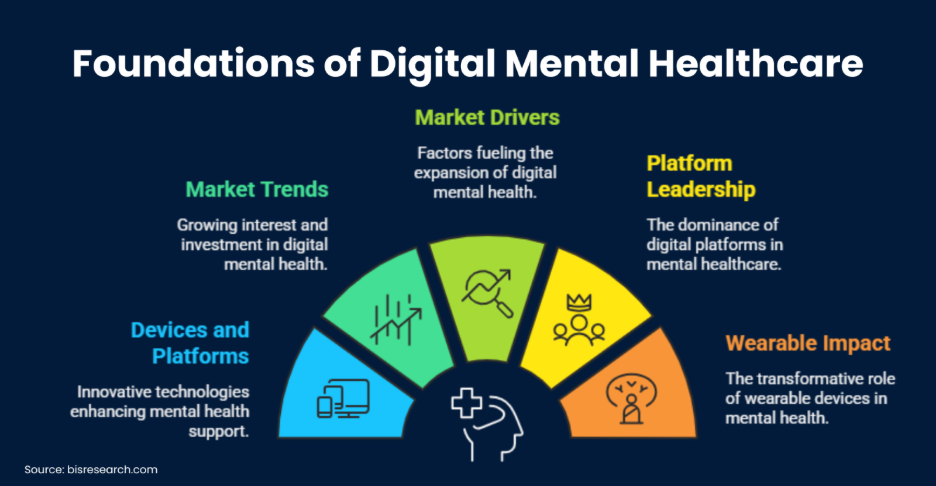
Mental health platforms are expected to lead because they are scalable and can combine multiple services in one place. A single platform can offer virtual therapy, digital coaching, AI mental health support, wellness tracking, anxiety support, depression care, self-care tools, and progress monitoring.
Employers are also becoming major adopters. Workplace mental health is now linked to productivity, retention, burnout prevention, and employee engagement. NAMI’s 2025 workplace mental health poll found that workers consider mental health at work important but need more information and support from leadership.
Preview market insights, forecasts, and research scope before accessing the full report.
-Request a sample report
Wearable mental health devices are making behavioral health more measurable. These tools can track stress signals, heart-rate variability, sleep quality, relaxation patterns, and emotional well-being indicators.
While they do not replace therapists or psychiatrists, they can support early intervention and personalized mental health care. AI-enabled systems can also identify patterns, recommend resources, and help users access support before symptoms worsen.
The biggest challenge is trust. Mental health data is highly sensitive, data privacy, cybersecurity, transparency, regulatory complexity, integration challenges, and variable clinical validation as major barriers.
The future of mental health technology will depend on solutions that are clinically validated, privacy-first, AI-enabled, easy to use, and integrated with healthcare systems.
Emerging mental health devices and platforms are not replacing therapy. They are making mental healthcare more accessible, continuous, personalized, and preventive, which is why this market is becoming one of the most important digital health opportunities of the next decade.