
The quantum computing market recorded several commercially significant announcements during the first seven months of 2026. The following developments focus exclusively on what companies are building, acquiring, deploying, or developing through strategic partnerships. Research papers, market forecasts, and developments announced before 2026 have been excluded.
Step Inside the Future of Quantum Computing
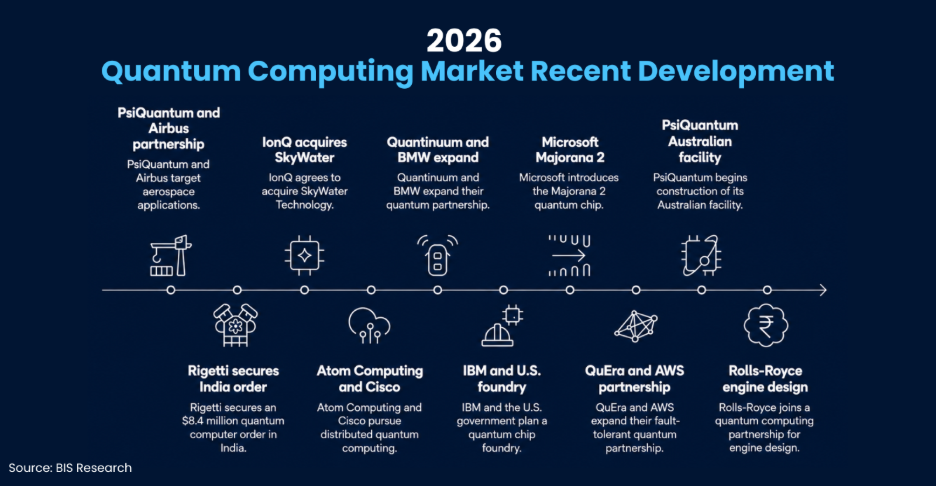
On January 13, PsiQuantum announced a collaboration with Airbus under the QuLAB project. The companies will develop and evaluate fault-tolerant quantum algorithms for complex fluid mechanics problems, including computational challenges associated with aircraft design and aerospace engineering.
See What the Complete Quantum Computing Report Covers
On January 20, Rigetti received an $8.4 million order from India’s Centre for Development of Advanced Computing. Rigetti will deliver a 108-qubit superconducting quantum computer for installation at C-DAC’s Bengaluru supercomputing centre during the second half of 2026.
IonQ announced a definitive agreement on January 26 to acquire semiconductor foundry SkyWater Technology for approximately $1.8 billion. The transaction is designed to give IonQ integrated access to domestic chip fabrication, packaging, prototyping, and advanced manufacturing capabilities.
Get a First Look at the Market Insights- Request a sample report now
On March 25, Atom Computing and Cisco signed a memorandum of understanding to explore how neutral-atom quantum computers could be connected through quantum networks. The collaboration addresses the interconnect and networking requirements needed to scale beyond individual quantum processors.
Quantinuum and BMW Group expanded their collaboration into a multi-year partnership on May 5. BMW will access future Quantinuum systems while the companies jointly investigate quantum computing applications in advanced materials science, battery technology, mobility, and manufacturing.
IBM and the U.S. Department of Commerce announced a letter of intent on May 21 to support a purpose-built American quantum chip foundry. The proposed initiative will support Anderon, a new IBM company focused on expanding domestic quantum-device manufacturing.
Microsoft unveiled Majorana 2 on June 2. According to the company, the next-generation topological quantum chip uses an improved materials stack and contains qubits that are 1,000 times more reliable than those in its previous generation.
On June 15, QuEra announced Libra, its first planned fault-tolerant quantum computer, alongside an expanded multi-year partnership with Amazon Web Services. Libra is expected to become accessible through Amazon Braket in 2028 for commercial, government, and scientific workloads.
PsiQuantum broke ground on June 18 at Moreton Bay Central in Queensland. The facility is intended to house a utility-scale, fault-tolerant photonic quantum computer supported by semiconductor manufacturing and cryogenic infrastructure.
On July 14, Quantinuum, Rolls-Royce, Riverlane, and the University of Edinburgh’s EPCC announced an agreement to examine quantum computing requirements for future industrial workflows. Initial applications include gas-turbine modelling, engine design, and large-scale engineering simulation.
Quantum computing activity in 2026 is increasingly centred on manufacturing capacity, industrial applications, fault-tolerant architectures, quantum networking, and commercial infrastructure. Aerospace, automotive, government, cloud computing, and semiconductor companies are becoming direct participants rather than waiting for fully mature quantum systems.