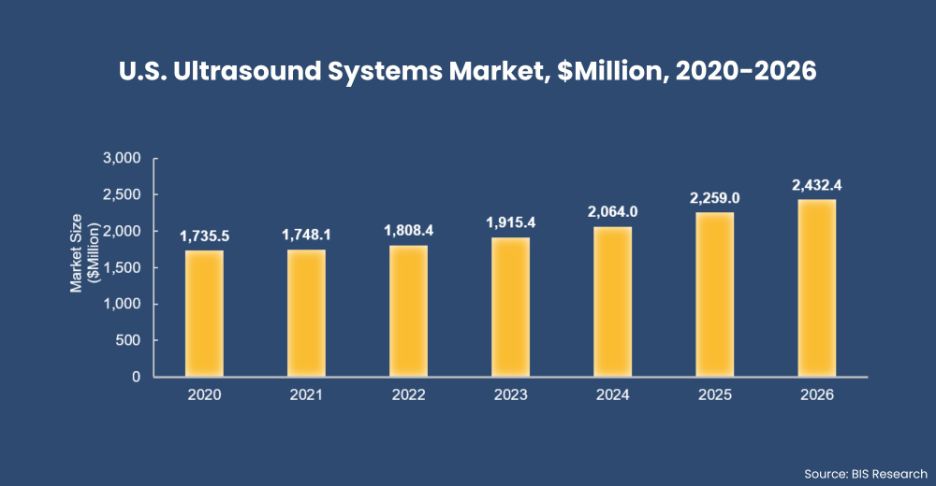
The U.S. ultrasound systems market is growing steadily as ultrasound becomes more important across diagnostic imaging, point-of-care use, and routine clinical examinations. Based on the provided market assessment, the U.S. ultrasound systems market was valued at $1,735.5 million in 2020 and is estimated to reach $2,432.4 million by 2026.
This growth is being supported by multiple factors, including the rising need for examinations due to chronic diseases, the adoption of point-of-care ultrasound systems, the integration of artificial intelligence, and improving ultrasound workflow. The market is also benefiting from wide use across general imaging, cardiology imaging, obstetrics and gynecology imaging, lung imaging, vascular imaging, urology imaging, orthopedic imaging, and other procedures.
Looking for detailed market sizing, segmentation, and competitive insights? Request a quote for the U.S. Ultrasound Systems Market report.
One of the major drivers shown in the assessment is the rising need for examination due to the increasing prevalence of chronic diseases. Ultrasound is used across several clinical areas because it helps in examining different parts of the body and identifying injuries, abnormalities, and disease-related conditions.
The procedure volume data supports this trend. Total ultrasound procedure volume in the U.S. was 85.59 million in 2020 and is estimated to reach 95.77 million by 2026. This shows a clear rise in the use of ultrasound examinations across the country.
The largest procedure volume comes from the 18-64 age group. This group accounted for 54.21 million ultrasound procedures in 2020 and is estimated to reach 59.34 million procedures by 2026. The 65 and above age group is also growing, increasing from 26.86 million procedures in 2020 to an estimated 31.59 million procedures in 2026. This indicates that ultrasound demand is being driven by both adult healthcare needs and the growing diagnostic requirements of older patients.
Need procedure-level insights for opportunity mapping or strategy planning? Explore Surgical Procedure Volume Database to understand procedure volumes across key healthcare segments.
 ?
?
The advent of point-of-care ultrasound systems is another important growth driver. Point-of-care ultrasound allows imaging to be used closer to the patient, supporting quicker diagnosis and clinical decision-making.
The portability data from the assessment shows that standalone ultrasound systems held the largest share in 2020 at 73.0%. Portable ultrasound systems accounted for 23.7%, while handheld or wireless ultrasound systems accounted for 3.3%.
Although standalone systems remained dominant in 2020, the report indicates that the market is expected to witness growth in portable and handheld ultrasound systems. This shift is important because healthcare providers increasingly need ultrasound systems that are easier to move, faster to deploy, and suitable for different care settings.
The integration of artificial intelligence into ultrasound is listed as a key driver in the provided assessment. AI can support ultrasound systems by helping improve workflow, efficiency, and imaging processes.
This connects with another market opportunity identified in the images: improving ultrasound workflow. As procedure volumes increase, healthcare providers need systems that can support faster and more efficient examinations. AI-enabled capabilities and workflow improvements can help reduce operational pressure and make ultrasound systems more useful across high-volume clinical environments.
Want to understand how these trends affect your business strategy? Schedule a call with our team to discuss the U.S. ultrasound systems market.
General imaging is one of the most important application areas in the U.S. ultrasound systems market. According to the assessment, the general imaging segment accounted for 28.4% of the U.S. market in 2020.
General imaging is used to examine body areas such as the chest, spine, skull, hips, pelvis, and abdomen. It helps clinicians understand injuries, abnormalities, and diseases. This broad clinical use makes general imaging a strong contributor to overall market demand.
Other important application areas include cardiology imaging, obstetrics and gynecology imaging, lung imaging, vascular imaging, urology imaging, orthopedic imaging, and other imaging procedures. The wide range of applications helps explain why ultrasound systems continue to be adopted across different healthcare settings.
Technology advancement is identified as a major market opportunity. In 2020, 2D ultrasound held the largest technology share at 67.4%. The 3D/4D ultrasound segment accounted for 29.1%, while other technologies accounted for 3.5%.
The assessment also highlights technology developments such as 3D structural analysis, real-time imaging, 4D imaging, HD live imaging, automation, and 5D ultrasound. These advancements are making ultrasound systems more capable and useful across diagnostic and clinical applications.
Through 2026, the U.S. ultrasound systems market is expected to grow due to rising procedure volumes, increasing demand for examination, point-of-care ultrasound adoption, AI integration, and technology advancement. With market revenue estimated to rise from $1,735.5 million in 2020 to $2,432.4 million in 2026, ultrasound systems are becoming a more important part of U.S. healthcare delivery.