The U.S. ultrasound systems market is creating opportunities across several clinical applications as diagnostic imaging becomes more widely used in routine examinations, specialty care, and point-of-care settings. Based on the provided market assessment, the U.S. ultrasound systems market was valued at $1,735.5 million in 2020 and is estimated to reach $2,432.4 million by 2026.
The major application areas include general imaging, cardiology imaging, obstetrics and gynecology imaging, lung imaging, vascular imaging, urology imaging, and orthopedic imaging. These applications are supported by rising procedure volumes, technology advancement, artificial intelligence integration, and the need for improved ultrasound workflow.
General imaging is the strongest application area in the U.S. ultrasound systems market. According to the provided assessment, the general imaging segment accounted for 28.4% of the U.S. market in 2020, making it the leading application segment.
General imaging includes examination of different areas of the body, such as the chest, spine, skull, hips, pelvis, and abdomen. It is mainly used to understand the cause of injury, abnormality, or disease-related conditions. Because it supports multiple diagnostic needs, general imaging has broad use across hospitals, diagnostic imaging centers, and other healthcare settings.
Its leading position is also supported by the availability of a wide variety of ultrasound products catering to several imaging modalities.
Looking for detailed application-level market sizing and segmentation? Request a quote for the U.S. Ultrasound Systems Market report.
Cardiology imaging is another important application area in the U.S. ultrasound systems market. It is listed among the common ultrasound procedures in the assessment and appears as a key category in the application attractiveness analysis.
The market’s procedure volume data shows growing ultrasound usage. Total U.S. ultrasound procedure volume increased from 85.59 million in 2020 to an estimated 95.77 million in 2026. The largest procedure group is the 18-64 age group, which increased from 54.21 million procedures in 2020 to 59.34 million in 2026. The 65 and above age group also increased from 26.86 million procedures in 2020 to 31.59 million in 2026.
This rising procedure base supports continued demand for major clinical applications, including cardiology imaging.
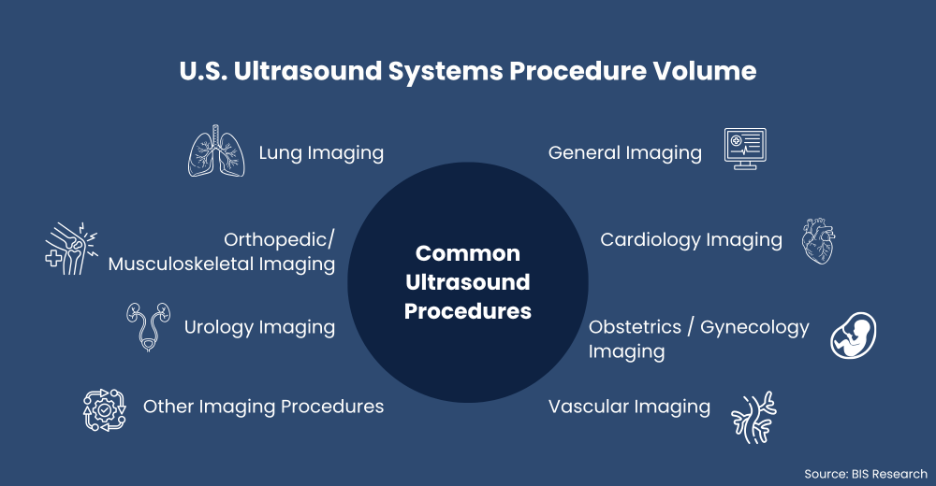
Obstetrics and gynecology imaging remains one of the core ultrasound applications. It is included in both the application attractiveness analysis and the list of common ultrasound procedures.
This application continues to support ultrasound system demand because ultrasound is a non-invasive imaging technique and is widely incorporated into physician-led diagnosis. Its routine clinical relevance makes it a stable contributor to the overall market.
Lung imaging and vascular imaging are also important opportunity areas. Both are included among the common ultrasound procedures in the assessment.
These applications benefit from the growing role of point-of-care ultrasound systems. The assessment identifies the advent of point-of-care ultrasound systems as a key market driver. This matters because point-of-care ultrasound supports quicker examinations and allows imaging to be used closer to the patient.
The portability data also supports this trend. In 2020, standalone ultrasound systems accounted for 73.0% of the market by portability, while portable ultrasound systems accounted for 23.7% and handheld or wireless ultrasound systems accounted for 3.3%. The assessment notes that portable and handheld ultrasound systems are expected to see growing adoption.
Need procedure-volume insights by age group, region, or care setting? Explore SPVD for deeper opportunity mapping.
Urology imaging and orthopedic imaging expand the ultrasound market beyond broad diagnostic use. The assessment lists urology imaging and orthopedic/musculoskeletal imaging among common ultrasound procedures.
These applications show how ultrasound systems are being used across specialized clinical areas where real-time imaging, accessibility, and efficient examination workflows are important.
Technology advancement is another factor supporting ultrasound applications. In 2020, 2D ultrasound held 67.4% of the market by technology, while the 3D-related segment accounted for 29.1% and others accounted for 3.5%.
The assessment also highlights developments such as 3D structural analysis, real-time imaging, 4D imaging, HD live imaging with automation, and 5D ultrasound development. These improvements can strengthen the usefulness of ultrasound across general imaging, cardiology, obstetrics and gynecology, lung imaging, vascular imaging, urology, and orthopedic imaging.
Want to identify the most relevant ultrasound application opportunities for your business? Schedule a call with our team.
The biggest opportunity in the U.S. ultrasound systems market comes from general imaging, supported by its leading market share and broad diagnostic use. However, cardiology imaging, obstetrics and gynecology imaging, lung imaging, vascular imaging, urology imaging, and orthopedic imaging also contribute to market expansion.
With market revenue estimated to rise from $1,735.5 million in 2020 to $2,432.4 million in 2026, ultrasound applications are becoming more important across U.S. healthcare delivery.