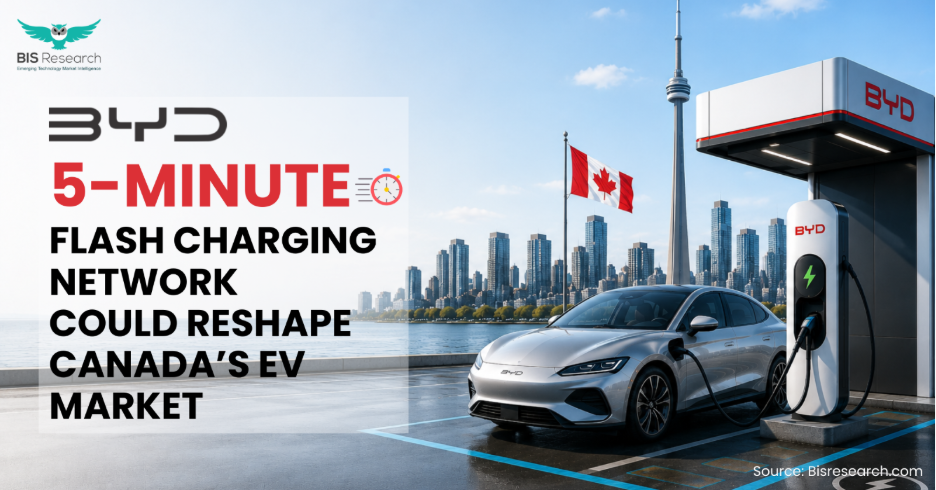
BYD is preparing to take its ultra-fast “Flash Charging” network to Canada, a move that would mark the technology’s first confirmed deployment in North America. The role is focused on executing BYD’s charging-network expansion strategy across Canada, signaling that the automaker is preparing to sell vehicles in the country and build the infrastructure needed to support them.
The technology behind the plan is ambitious. BYD introduced its 1,000 kW Flash Charging system with its 1,000-volt Super e-Platform in March 2025, then upgraded the system this year with its second-generation Blade Battery and charging capability of up to 1,500 kW. BYD says the system can add roughly 250 miles, or 400 kilometers, of range in about five minutes. In China, the company has built more than 5,700 Flash Charging stations in around a year, giving it a strong operating base before taking the technology overseas. The latest hardware is designed for high-voltage vehicles drawing large currents, with battery storage integrated at stations to reduce stress on grids.
Explore the Electric Vehicle Fast-Charging System Market Report to understand how ultra-fast charging is reshaping the EV infrastructure race:
The Canadian job listing suggests BYD is looking for partners in power-grid upgrades, equipment installation, station operations, and construction management. The selected manager would also work on cost and profit models, subsidy policies, network planning, and coordination with BYD headquarters. This points to a more integrated strategy than simply relying on third-party charging networks. It also mirrors an approach Tesla used early in its Electric Vehicle expansion: reducing charging anxiety by controlling a reliable, brand-linked charging experience. For a new entrant, that could matter as much as pricing, range, or model availability.
Explore the Electric Vehicle Charge Point System Market Report to uncover key opportunities in next-generation EV charging networks:
Canada could be a strategic testing ground for BYD’s North American ambitions. The country has lowered its 100% surtax on Chinese-made EVs, with a permit-based quota system now applying to imports from China, while BYD has reportedly been preparing a dealership rollout starting in Toronto. Cold-weather performance is another key factor. BYD says its second-generation Blade Battery can charge from 10% to 70% in about five minutes even at minus 20 degrees Celsius, a claim that directly targets one of Canada’s biggest EV adoption barriers. The remaining questions are timing, permitting, grid readiness, and how quickly BYD can install stations before its vehicles arrive. If the rollout proceeds, Canada may become the first North American market to experience megawatt-class EV charging at commercial scale.