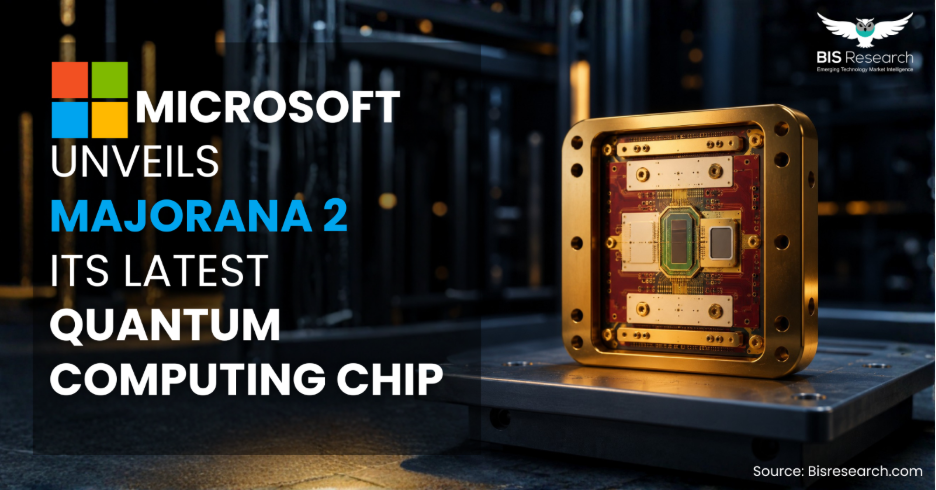
Microsoft’s latest quantum computing update is more than another chip announcement. With Majorana 2, the company is trying to show that the race toward practical quantum computing may move faster when advanced hardware meets agentic AI.
Majorana 2 is built around topological qubits, a type of qubit designed to be more stable and less vulnerable to errors than many conventional quantum systems. Stability matters because quantum computers are extremely sensitive to noise, temperature changes, and tiny environmental disturbances. Even small errors can make calculations unreliable. Microsoft says Majorana 2 improves qubit reliability significantly compared with its earlier work, which could bring the industry closer to scalable quantum machines.
A major part of this progress comes from Microsoft Discovery, the company’s agentic AI platform for scientific research. Instead of relying only on slow trial-and-error lab work, Microsoft used AI agents to help identify better materials, optimize experiments, analyze results, and support faster decision-making. This is important because quantum computing is not just a software challenge. It depends heavily on breakthroughs in materials science, chip design, and advanced manufacturing.
Want deeper insights into the rapidly evolving quantum processors market? Request a customized quote today.
The company’s approach also points to a larger shift in deep technology: AI is no longer just helping people write code or summarize data. It is starting to act as a research partner. In fields such as quantum computing, drug discovery, energy storage, and semiconductor development, agentic AI could shorten development timelines by testing ideas faster and helping researchers focus on the most promising paths.
For businesses and governments, the implications are significant. A reliable, fault-tolerant quantum computer could one day transform complex simulations, cybersecurity, logistics, climate modeling, financial risk analysis, and molecular research. That said, quantum computing still has a long road ahead. Microsoft’s claims will need continued scientific validation, and the industry must still solve major challenges around scaling, error correction, and commercial deployment.
Explore market forecasts, technology trends, and competitive analysis. Download the complete Table of Contents.
Even so, Majorana 2 is an important signal. It suggests that the future of quantum computing may not depend on hardware innovation alone. The next major leap could come from the combination of quantum chips, advanced materials, and AI systems that help scientists discover faster.
Request an updated version on Quantum Processor Market