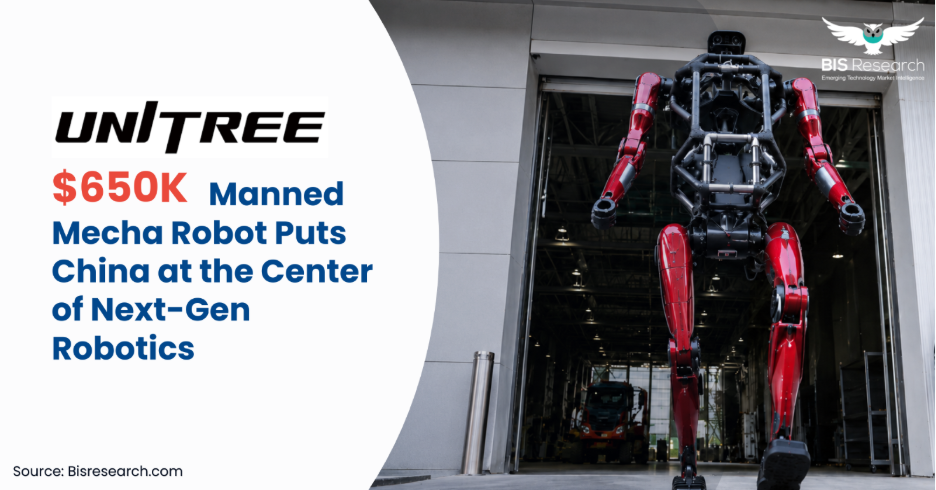
China’s Unitree Robotics has introduced the GD01, a giant piloted robot that looks like it has stepped out of science fiction and into the real world. The company describes GD01 as the world’s first production-ready manned mecha, with a starting price of 3.9 million yuan, or about $650,000. According to reports, the robot is roughly 2.7 meters tall and weighs about 500 kilograms, including the driver.
What makes the Unitree GD01 important is not only its size, but its mobility. Demonstration footage shows the robot walking upright on two legs, using mechanical arms to break through a brick wall, and then folding into a four-legged mode for movement across rougher terrain. This bipedal and quadrupedal transformation gives GD01 a hybrid design, combining humanoid balance with animal-like stability.
The technology behind GD01 reflects Unitree’s broader push into embodied AI, where machines use sensors, motors, control systems, and artificial intelligence to interact with physical environments. Unitree’s existing humanoid robots, such as the G1, already use high-precision joint motors, force-position control, depth cameras, 3D LiDAR, lithium batteries, and AI-driven motion systems. These capabilities show how the company is building a robotics ecosystem that goes beyond entertainment and into real-world applications.
Explore humanoid robot market
For now, GD01 appears more like a high-profile technology demonstrator than a mass-market machine. Analysts have pointed to several practical challenges, including battery life, safety, maintenance complexity, pilot comfort, and real-world usefulness. However, possible applications could emerge in hazardous inspections, rescue operations, theme parks, film production, defense-adjacent simulations, and industrial demonstrations.
For now, GD01 appears more like a high-profile technology demonstrator than a mass-market machine. Analysts have pointed to several practical challenges, including battery life, safety, maintenance complexity, pilot comfort, and real-world usefulness. However, possible applications could emerge in hazardous inspections, rescue operations, theme parks, film production, defense-adjacent simulations, and industrial demonstrations.
See the full market structure & identify growth opportunities in humanoid robot market before the competition moves- Download Complete TOC
The launch also arrives at a strategic moment for China’s robotics sector. China released a national standard system in 2026 covering humanoid robots and embodied AI, including safety, ethics, intelligent computing, components, applications, and lifecycle management. Unitree also said it shipped more than 5,500 humanoid robots in 2025, underlining its growing manufacturing scale.
Get a data-backed preview of key trends, companies, and forecasts shaping the market.
- Request a Sample Report on Humanoid robots
The Unitree GD01 may not become a common vehicle soon, but it is a clear signal: robotics is moving from factory cages and research labs into public imagination, commercial branding, and potentially dangerous work environments. For China, GD01 is less just a robot and more a statement about the future of embodied AI.