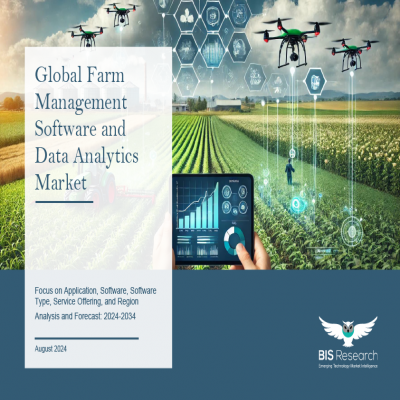
The Country-Wise Analysis of Farm Management Software Vendors Market Overview
The report evaluates the country-wise analysis of farm management software vendors market with a focus on how integrated digital platforms are transforming the management, documentation, and optimization of agricultural operations. It examines the evolution of country-wise farm management software (FMS) as an operational infrastructure that consolidates agronomic, operational, financial, and compliance data into structured workflows supporting farm-level and enterprise-level decision-making. The analysis emphasizes commercially deployed cloud-based and hybrid platforms that integrate crop planning, field activity logging, input management, telemetry, analytics, and regulatory reporting. The study also assesses how structural digitization in agriculture, driven by scale intensification, sustainability requirements, regulatory compliance, and data-enabled mechanization, is accelerating the adoption of farm management software across global farming systems.
Market Introduction
The country-wise analysis of farm management software vendors market is evolving alongside the growing maturity of precision agriculture systems, where digital workflow integration builds on existing mechanization, guidance technologies, and data capture infrastructure. Adoption levels vary significantly across regions depending on farm size concentration, machinery penetration, advisory ecosystem strength, and regulatory requirements. In highly mechanized markets such as the U.S. and Canada, GNSS guidance, auto-steer systems, and machine telemetry generate structured field data that simplify digital documentation and accelerate FMS adoption across large commercial farms. In Western Europe, regulatory frameworks related to environmental compliance, nutrient reporting, and traceability further reinforce the need for structured digital farm records. Meanwhile, scale-driven agricultural systems in Brazil and Australia rely on farm management platforms to coordinate operations across large, geographically dispersed farms. Emerging markets such as China show selective adoption through institutional farming initiatives, while India faces constraints due to smallholder fragmentation and inconsistent mechanization levels. Overall, the expansion of digitally managed acreage closely aligns with the structural readiness of agricultural systems, making precision agriculture maturity a key driver of country-wise analysis of farm management software vendors market growth.
Industrial Impact
The adoption of farm management software (FMS) is generating a significant transformation across the agricultural industry by shifting farm operations from fragmented recordkeeping toward integrated, data-driven management systems. These platforms consolidate agronomic, operational, financial, and compliance data into unified digital workflows, enabling farmers and agribusinesses to coordinate planning, execution, and monitoring of field activities with greater efficiency. By integrating machine telemetry, input tracking, and remote sensing insights, FMS allows producers to monitor field performance in near real time, optimize input usage, and improve yield forecasting. The technology also strengthens regulatory compliance and traceability by automating documentation for environmental reporting, nutrient management, and sustainability standards. As farms become larger and more operationally complex, these platforms provide centralized visibility across multiple fields and production cycles, supporting better resource allocation and cost management. Additionally, the integration of analytics and benchmarking tools enables farmers to evaluate performance across seasons and locations, improving long-term strategic planning. Overall, farm management software is accelerating the transition toward digitally coordinated agriculture, enhancing productivity, operational transparency, and resilience across global farming systems.
Market Challenges
A major challenge in the country-wise analysis of farm management software vendors market is the fragmented digital ecosystem and lack of interoperability across agricultural platforms. Farms often rely on multiple systems, including OEM telematics, agronomy software, irrigation controls, accounting tools, and livestock management platforms that operate in isolated environments with limited data exchange. This fragmentation leads to operational inefficiencies such as duplicate data entry, inconsistent data formats, and difficulty in generating unified farm-level insights. Although API-based integrations are gradually improving connectivity, many platforms still operate within proprietary ecosystems, limiting seamless data portability and slowing the development of integrated digital workflows.
Another significant barrier is skills gaps, trust concerns, and uncertainty around return on investment (ROI). Digital literacy varies widely across farm sizes and regions, and many operators lack the expertise required to interpret advanced analytics or predictive insights generated by these platforms. At the same time, farmers remain cautious about data ownership, potential misuse of farm-level information, and long-term data portability when switching providers. For smaller farms in particular, subscription costs may appear as fixed expenses without clear financial returns, which can slow adoption despite the long-term benefits of digital farm management solutions.
Future Impact
The farm management software (FMS) industry is expected to significantly transform modern agriculture by enabling farmers to make more accurate and data-driven decisions. By integrating technologies such as sensors, satellite imagery, weather forecasting, and data analytics, farm management software allows farmers to monitor soil conditions, crop health, and resource usage in real time. This improves planning for irrigation, fertilization, and harvesting, leading to higher productivity and reduced waste. As agriculture faces increasing pressure to produce more food with limited land and resources, these digital tools will play a crucial role in improving efficiency and supporting sustainable farming practices.
Another major impact of farm management software is the advancement of precision agriculture. Through the use of GPS-enabled machinery, IoT devices, and drone monitoring, farmers can manage different parts of their fields based on specific needs rather than treating the entire farm uniformly. This targeted approach helps reduce excessive use of water, fertilizers, and pesticides while maintaining crop quality. As a result, farm management software contributes to environmental sustainability by conserving natural resources and minimizing the ecological footprint of agricultural activities.
Farm management software also enhances the business and operational side of farming. Modern platforms help farmers track farm finances, manage inventories, monitor labor activities, and maintain detailed records of production. These features enable farmers to analyze performance over time and make strategic decisions that improve profitability and risk management. In addition, digital record-keeping improves transparency across the agricultural supply chain, allowing better traceability of products from farm to market. This transparency strengthens consumer trust and supports quality assurance in food production.
Analyst View
According to Dhrubajyoti Narayan, Principal Analyst at BIS Research, the farm management software (FMS) industry is evolving into a core operational platform that supports data-driven decision-making across modern agricultural systems. Adoption is strongly linked to the structural maturity of farming environments, particularly the level of mechanization, availability of connected machinery, and regulatory requirements for digital documentation. These platforms are increasingly integrating agronomic, operational, financial, and compliance data into unified workflows that enhance planning, monitoring, and resource optimization. While the industry is benefiting from the expansion of precision agriculture and data-enabled mechanization, adoption remains influenced by interoperability challenges, fragmented digital ecosystems, and varying levels of digital literacy among farmers. Concerns related to data ownership and uncertain short-term returns on investment also affect adoption in smaller farming systems. Nevertheless, FMS platforms are expected to become central decision-support systems as agriculture continues its transition toward digitally coordinated and analytics-driven farm management.