A quick peek into the report
Table of Contents
1.1 Trends: Current and Future Impact Assessment
1.1.1 Swarm-Mitigation Strategies
1.1.2 Autonomous Response and Decision-Support Systems
1.1.3 Integration with C4ISR and Battle-Management
1.1.4 Miniaturization and Portability Trends
1.1.5 Commercial-Civil Fusion
1.2 Supply Chain Overview
1.2.1 Key Players within the Supply Chain
1.2.2 Value-Chain Analysis
1.3 Patent Analysis
1.3.1 Patent Filing Trend (by Country)
1.3.2 Patent Filing Trend (by Company)
1.4 Regulatory Landscape
1.4.1 National Counter-UAS Frameworks
1.4.1.1 EU Member-State Policies
1.4.2 Export Controls and ITAR/EAR: Restrictions on Cross-Border Transfer of C-UAS Hardware/Software
1.4.3 Spectrum Allocation and Jamming Permissions: Licensing Processes for RF Mitigation Equipment
1.4.4 Privacy, Data Protection, and Airspace Rights: Emerging Laws around Drone Tracking Data and National Airspace Access
1.4.5 International Coordination and Standards: NATO STANAGs, ICAO Guidance on UAS Integration and Counter-Measures
1.5 Technological Analysis
1.5.1 Sensor Fusion Architectures: EKF, AI-Driven Data Fusion Combining RF, Radar, EO/IR, and Acoustic Inputs
1.5.2 Detection Sub-Systems: RF Signature Scanners, UHF/VHF/GPS Spoofing Identification, 4D AESA Radar Performance
1.5.3 Platform Form Factors: Handheld vs. Vehicle-Mounted vs. Fixed-Site Modular Units
1.5.4 Emerging Tech and R&D Focus: Quantum-Radar Proof-of-Concepts, Anti-Swarm AI Algorithms, Micro-DEW Prototypes
1.6 Case Studies
1.6.1 Case Study: Spanish Air Force, Defense, Europe
1.6.2 Case Study: World Economic Forum, Davos – Swiss Police Anti-Drone Defense, Homeland Security/VIP Protection, Europe
1.6.3 Case Study: Gatwick Airport – British Army Deployment of Drone Dome, Homeland Security, Europe
1.6.4 Case Study: Spanish Prisons – Drone Threat Mitigation, Homeland Security, Europe
1.7 Ongoing/Upcoming Programs and Contracts in Counter-UAS (Anti-Drone) Technology
1.8 Market Dynamics
1.8.1 Drivers, Challenges, and Opportunities: Current and Future Impact Assessment
1.8.2 Market Drivers
1.8.2.1 Growth in Defense and Homeland-Security Budgets
1.8.2.2 Geopolitical Tensions and Conflict-Driven Demand
1.8.2.3 Proliferation of UAVs
1.8.2.4 Critical Infrastructure Protection Needs
1.8.2.5 Technological Enablers (AI, Sensor Fusion)
1.8.3 Market Challenges
1.8.3.1 High-Cost System and Lifecycle Costs
1.8.3.2 Regulatory and Legal Uncertainties
1.8.3.3 Technical Integration Complexity
1.8.3.4 Spectrum Congestion and RF Licensing
1.8.4 Market Opportunities
1.8.4.1 AI/ML-Enabled Autonomous C-UAS
1.8.4.2 Directed-Energy Weapon (DEW) Commercialization
1.8.4.3 Urban and Smart-City Security Solutions
2.1 Regional Summary
2.2 Europe
2.2.1 Regional Overview
2.2.2 Driving Factors for Market Growth
2.2.3 Factors Challenging the Market
2.2.4 Application
2.2.5 Product
2.2.6 Germany
2.2.6.1 Application
2.2.6.2 Product
2.2.7 France
2.2.7.1 Application
2.2.7.2 Product
2.2.8 U.K.
2.2.8.1 Application
2.2.8.2 Product
2.2.9 Italy
2.2.9.1 Application
2.2.9.2 Product
2.2.10 Russia
2.2.10.1 Application
2.2.10.2 Product
2.2.11 Rest-of-Europe
2.2.11.1 Application
2.2.11.2 Product
3.1 Airbus S.A.S.
3.1.1 Overview
3.1.2 Top Products/Product Portfolio
3.1.3 Top Competitors
3.1.4 Target Customers
3.1.5 Key Personnel
3.1.6 Analyst View
3.1.7 Market Share, 2024
3.2 Blighter Surveillance Systems Ltd.
3.2.1 Overview
3.2.2 Top Products/Product Portfolio
3.2.3 Top Competitors
3.2.4 Target Customers
3.2.5 Key Personnel
3.2.6 Analyst View
3.2.7 Market Share, 2024
3.3 Chess Dynamics Ltd.
3.3.1 Overview
3.3.2 Top Products/Product Portfolio
3.3.3 Top Competitors
3.3.4 Target Customers
3.3.5 Key Personnel
3.3.6 Analyst View
3.3.7 Market Share, 2024
3.4 Leonardo S.p.A.
3.4.1 Overview
3.4.2 Top Products/Product Portfolio
3.4.3 Top Competitors
3.4.4 Target Customers
3.4.5 Key Personnel
3.4.6 Analyst View
3.4.7 Market Share, 2024
3.5 Other Key Players
4.1 Data Sources
4.1.1 Primary Data Sources
4.1.2 Secondary Data Sources
4.1.3 Data Triangulation
4.2 Market Estimation and Forecast
Table 1: Market Snapshot
Table 2: Competitive Landscape Snapshot
Table 3: Drivers, Challenges, and Opportunities: Current and Future Impact Assessment, Global, 2024-2035
Table 4: Counter-UAV (Anti-Drone) Market (by Region), $Million, 2024-2035
Table 5: Europe Counter-UAV (Anti-Drone) Market (by End User), $Million, 2024-2035
Table 6: Europe Counter-UAV (Anti-Drone) Market (by Technology Type), $Million, 2024-2035
Table 7: Germany Counter-UAV (Anti-Drone) Market (by End User), $Million, 2024-2035
Table 8: Germany Counter-UAV (Anti-Drone) Market (by Technology Type), $Million, 2024-2035
Table 9: France Counter-UAV (Anti-Drone) Market (by End User), $Million, 2024-2035
Table 10: France Counter-UAV (Anti-Drone) Market (by Technology Type), $Million, 2024-2035
Table 11: U.K. Counter-UAV (Anti-Drone) Market (by End User), $Million, 2024-2035
Table 12: U.K. Counter-UAV (Anti-Drone) Market (by Technology Type), $Million, 2024-2035
Table 13: Italy Counter-UAV (Anti-Drone) Market (by End User), $Million, 2024-2035
Table 14: Italy Counter-UAV (Anti-Drone) Market (by Technology Type), $Million, 2024-2035
Table 15: Russia Counter-UAV (Anti-Drone) Market (by End User), $Million, 2024-2035
Table 16: Russia Counter-UAV (Anti-Drone) Market (by Technology Type), $Million, 2024-2035
Table 17: Rest-of-Europe Counter-UAV (Anti-Drone) Market (by End User), $Million, 2024-2035
Table 18: Rest-of-Europe Counter-UAV (Anti-Drone) Market (by Technology Type), $Million, 2024-2035
Table 19: Europe Market Share, 2024
Figure 1: Europe Counter-UAV (Anti-Drone) Market (by Scenario), $Billion, 2025, 2030, and 2035
Figure 2: Europe Counter-UAV (Anti-Drone) Market, 2024-2035
Figure 3: Market Snapshot, 2024
Figure 4: Counter-UAV (Anti-Drone) Market, $Million, 2024 and 2035
Figure 5: Europe Counter-UAV (Anti-Drone) Market (by End User), $Million, 2024, 2030, and 2035
Figure 6: Europe Counter-UAV (Anti-Drone) Market (by Technology Type), $Million, 2024, 2030, and 2035
Figure 7: Europe Counter-UAV (Anti-Drone) Market Segmentation
Figure 8: Supply-Chain Analysis in Counter-UAV (Anti-Drone) Market, 2024
Figure 9: Value-Chain Analysis in Counter-UAV (Anti-Drone) Market, 2024
Figure 10: Patent Filing Trend (by Country), January 2021-July 2025
Figure 11: Patent Filing Trend (by Company), January 2021-July 2025
Figure 12: Case Study: Spanish Air Force, Defense, Europe
Figure 13: Case Study: World Economic Forum, Davos – Swiss Police Anti-Drone Defense, Homeland Security/VIP Protection, Europe
Figure 14: Case Study: Gatwick Airport – British Army Deployment of Drone Dome, Homeland Security, Europe
Figure 15: Case Study: Spanish Prisons – Drone Threat Mitigation, Homeland Security, Europe
Figure 16: Programs and Contracts Analysis, 2021-2025
Figure 17: Strategic Initiatives, January 2021-July 2025
Figure 18: Data Triangulation
Figure 19: Top-Down and Bottom-Up Approach
Figure 20: Assumptions and Limitations
Europe Counter-UAV (Anti-Drone) Market Report Coverage
|
Europe Counter-UAV (Anti-Drone) Market |
|||
|
Base Year |
2024 |
Market Size in 2025 |
$1,292.0 Million |
|
Forecast Period |
2025-2035 |
Value Projection and Estimation by 2035 |
$9,819.8 Million |
|
CAGR During Forecast Period |
22.49% |
|
|
Some of the prominent names established in this market are:
• Airbus S.A.S.
• Blighter Surveillance Systems Ltd.
• Chess Dynamics Ltd.
• Leonardo S.p.A.
How This Report Can Add Value?
Product/Innovation Strategy: The product segment helps the reader understand the different types of services available globally. Moreover, the study provides the reader with a detailed understanding of the Europe counter-UAV (anti-drone) market by product, based on the method of end user, technology, and platform.
Growth/Marketing Strategy: The Europe counter-UAV (anti-drone) market has witnessed major development by key players operating in the market, such as business expansion, partnership, collaboration, and joint ventures. The favored strategy for the companies has been synergistic activities to strengthen their position in the market.
Competitive Strategy: Key players in the Europe counter-UAV (anti-drone) market have been analyzed and profiled in the study of counter-UAV (anti-drone) products. Moreover, a detailed competitive benchmarking of the players operating in the market has been done to help the reader understand how players stack against each other, presenting a clear market landscape. Additionally, comprehensive competitive strategies such as partnerships, agreements, and collaborations will aid the reader in understanding the untapped revenue pockets in the market.
Methodology: The research methodology design adopted for this specific study includes a mix of data collected from primary and secondary data sources. Both primary resources (key players, market leaders, and in-house experts) and secondary research (a host of paid and unpaid databases), along with analytical tools, have been employed to build the predictive and forecast models.
Europe Counter-UAV (Anti-Drone) Market Overview
The Europe counter-UAV (anti-drone) market is witnessing rapid expansion, driven by escalating security concerns, geopolitical tensions, and increasing drone proliferation across civilian and military domains. The Europe counter-UAV (anti-drone) market is projected to grow from $1,292.0 million in 2025 to $9,819.8 million by 2035, at a CAGR of 22.49%, reflecting strong regional growth momentum. Europe is emerging as a key contributor, supported by rising investments in defense modernization and critical infrastructure protection. Governments across the region are accelerating deployment of advanced detection and interdiction technologies, positioning Europe as a strategic hub for anti-drone innovation and adoption.
Market Introduction
The Europe counter-UAV (anti-drone) market is becoming a critical component of modern defense and security infrastructure. Counter-UAV systems are designed to detect, track, identify, and neutralize unauthorized or hostile drones using technologies such as radar, radio-frequency (RF) detection, electronic jamming, and kinetic interception.
With the rapid proliferation of unmanned aerial vehicles (UAVs) across commercial, recreational, and military applications, Europe has witnessed a surge in drone-related threats. These include unauthorized surveillance, smuggling, cyber vulnerabilities, and potential drone-based attacks on critical infrastructure such as airports, power plants, and defense installations.
Recent geopolitical developments, including rising cross-border tensions and drone incursions, have further accelerated demand for advanced counter-UAV systems across European nations. Governments are increasingly investing in integrated airspace security frameworks, including initiatives such as continent-wide drone defense systems and national anti-drone shields.
Additionally, the commercialization of drone technologies has expanded the need for anti-drone solutions in civilian sectors such as public safety, event security, and industrial facilities. This dual-use demand is fostering innovation, encouraging collaborations between defense contractors, technology firms, and regulatory bodies. As a result, the Europe counter-UAV market is evolving into a highly dynamic ecosystem, combining advanced technologies with regulatory frameworks to ensure comprehensive airspace protection.
Market Segmentation:
Segmentation 1: By End User
• Defense
• Commercial
• Homeland Security
Segmentation 2: By Technology Type
• Detection
• Interdiction
Segmentation 3: by Country
• Germany
• U.K.
• France
• Italy
• Russia
• Rest-of-Europe
Among these, the defense segment is expected to dominate due to increasing military adoption and rising geopolitical threats, while detection technologies are gaining traction with AI-powered systems enabling real-time monitoring and response.
Market Trends, Drivers, and Challenges
Market Trends
• Integration of AI and machine learning in drone detection systems for real-time threat analysis
• Development of swarm-mitigation and autonomous response systems
• Increasing deployment of integrated detection and disruption solutions across Europe
• Growing adoption of non-destructive mitigation techniques such as electronic countermeasures
Market Drivers
• Rising incidents of unauthorized drone activities and security breaches
• Increasing defense budgets and modernization programs across European countries
• Growing need to protect critical infrastructure and public spaces
• Expansion of drone applications leading to parallel demand for countermeasures
Market Challenges
• High cost of advanced counter-UAV systems and deployment infrastructure
• Regulatory and legal restrictions on drone interception technologies
• Complexity in detecting small, fast-moving, and low-altitude drones
• Risk of collateral damage in kinetic mitigation approaches
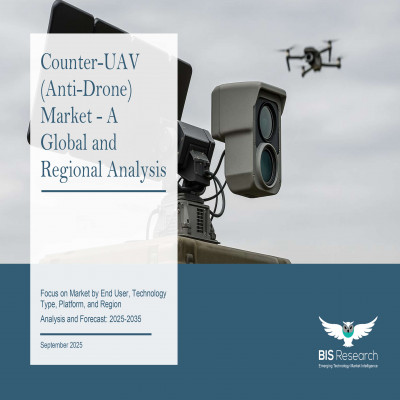
Europe Counter-UAV (Anti-Drone) Market
Focus on End User, Technology Type, and Country - Analysis and Forecast, 2025-2035
Frequently Asked Questions
Counter-UAV systems are technologies designed to detect, track, and neutralize unauthorized or malicious drones using methods such as radar detection, RF jamming, and kinetic interception.
Key drivers include rising security threats, increasing drone adoption, growing defense investments, and the need to protect critical infrastructure.
The defense segment dominates due to high demand for military-grade anti-drone solutions and increasing geopolitical tensions.
Technologies include detection systems (radar, RF sensors) and interdiction systems (jamming, lasers, kinetic interceptors).
Major challenges include high system costs, regulatory constraints, and technical difficulties in detecting small and autonomous drones.
