Published Year: 2023
Laboratory Automation Market - A Global Market and Regional Analysis: Focus on Product, Application,
The global laboratory automation market was valued at $9.17 billion in 2022 and is anticipated...

Type, Product, Application, and End User Analysis - Analysis and Forecast, 2026-2036
Delivery Time: 1 Working Day
Get ISO Certified Research, Customization, Data Extraction, and Value-Added Services with All BIS Research Reports
BIS Research provides a comprehensive report library with unlimited access to data, insights, and market intelligence through Subscription.
Get Subscription Know More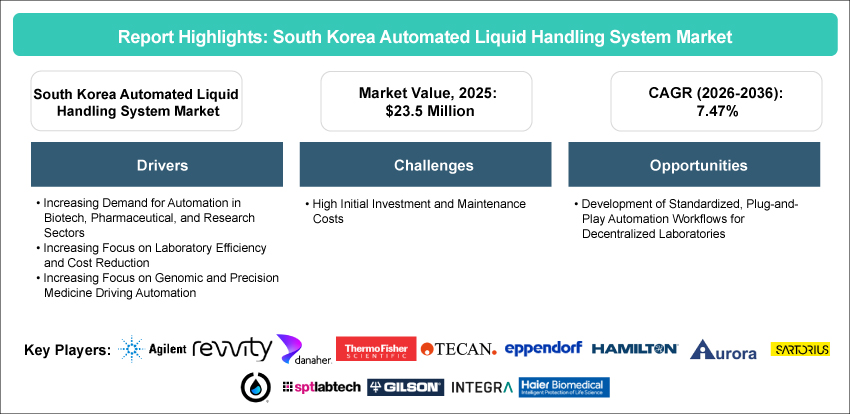
Introduction of the South Korea Automated Liquid Handling System Market
The South Korea automated liquid handling system market, initially valued at $23.5 million in 2025, is projected to witness substantial growth, surging to $51.0 million by 2036, marking a remarkable compound annual growth rate (CAGR) of 7.47% over the period from 2026 to 2036.
The South Korea automated liquid handling system market is experiencing significant growth, driven by increasing demand for efficiency, precision, and automation in laboratory environments.
As South Korea continues to prioritize advancements in biotechnology, pharmaceuticals, and clinical research, there is a growing need for high-throughput screening capabilities and more accurate, scalable laboratory processes. Automated liquid handling systems are vital in improving the consistency of sample preparation and testing, reducing human error, and boosting throughput while maintaining the integrity of results.
The rising trend toward personalized medicine, genomic research, and drug development further strengthens the demand for these systems. With an expanding focus on research and development (R&D) activities, the need for automation becomes even more critical to streamline operations, increase productivity, and reduce costs in laboratories.
Moreover, technological innovations, such as integrated robotic solutions and enhanced software for data management, are making automated liquid handling systems more versatile and user-friendly. These systems are being increasingly adopted across academic institutions, pharmaceutical companies, and clinical laboratories, where rapid, precise, and large-scale data generation is essential.
Government support for life sciences and healthcare infrastructure also plays a pivotal role in this market's growth, offering further impetus to automation adoption. With the increasing sophistication of the healthcare and research sectors in South Korea, the automated liquid handling system market is expected to continue flourishing, driven by both technological advancements and the ever-growing need for enhanced laboratory automation solutions.
Market Introduction
The South Korean market has undergone a shift toward automation in liquid-handling systems, propelled by the growing need for precision in high-throughput screening, sample preparation, and testing, particularly in the fields of biotechnology, pharmaceuticals, and clinical research. Automated systems are designed to handle complex liquid transfer tasks with high accuracy, improving laboratory productivity and reducing human error, making them indispensable tools in modern research and development processes.
The growing focus on personalized medicine, genomics, and drug discovery is further fueling demand for automated liquid-handling systems. These systems help streamline laboratory workflows, providing the flexibility and scalability needed for large-scale experiments and clinical trials. As South Korea continues to strengthen its life sciences and healthcare infrastructure, the adoption of automated liquid handling systems is expected to grow steadily, offering significant opportunities for market players in the coming years.
Industrial Impact
The South Korea automated liquid handling system market has witnessed significant growth, driven by the increasing demand for precision, efficiency, and scalability across various industrial sectors. This surge in market activity has had a profound impact on multiple industries, including biotechnology, pharmaceuticals, healthcare, and research, transforming the way laboratories operate and accelerating scientific progress.
In the biotechnology and pharmaceutical industries, automated liquid handling systems have become essential tools for improving research productivity. These systems facilitate high-throughput screening, sample preparation, and testing, ensuring consistent and accurate results while reducing the chances of human error. As drug discovery, molecular biology, and genetic research advance, these systems enable faster, more efficient handling of complex tasks, helping researchers meet the rising demand for new therapies and innovations in personalized medicine.
The healthcare sector also benefits from the adoption of automated liquid handling systems, especially in diagnostic laboratories and clinical settings. These systems streamline sample processing, ensuring faster turnaround times for test results while maintaining stringent quality control standards. As healthcare providers increasingly focus on improving patient outcomes, the adoption of automation in laboratories ensures enhanced operational efficiency and better resource utilization.
Additionally, the academic and research institutions are embracing automated liquid handling systems to support large-scale studies and complex experiments. The growing emphasis on genomics, proteomics, and precision medicine necessitates the need for high-accuracy, high-throughput systems capable of managing large volumes of data and samples efficiently.
As a result of these developments, the South Korea automated liquid handling system market is expected to continue to grow rapidly, reshaping industries by reducing manual labor, enhancing efficiency, and supporting cutting-edge scientific discoveries. The continued innovation of automated solutions will likely have even broader applications, offering opportunities for new industries to adopt these systems in their operations.
Market Segmentation:
Segmentation 1: By Type
• Automated Liquid Handling System
• Semi-Automated Liquid Handling System
Automated Liquid Handling System Segment to Dominate the South Korea Automated Liquid Handling System Market (by Type)
In terms of type, the automated liquid handling system segment is poised to lead the South Korea market, capturing a significant share due to its versatility, precision, and efficiency in laboratory operations. These systems are essential in industries such as pharmaceuticals, biotechnology, healthcare, and academic research, where high-throughput screening, accurate sample preparation, and reduced human error are critical. The growing demand for rapid and reliable results in drug discovery, genomics, and personalized medicine has fueled the need for automation in liquid handling processes. Automated systems not only ensure consistent accuracy but also enhance operational efficiency by reducing labor costs and processing times. Moreover, continuous advancements in technology, such as robotic integration and advanced software, have made these systems more sophisticated and easier to use, further driving their adoption. As these systems prove invaluable in improving productivity and scalability, the automated liquid handling system segment is set to dominate the market in the coming years.
Segmentation 2: By Product
• Liquid Handling Workstation
• Pipettors
• Microplate Reagent Dispensers
• Microplate Washers
• Others
Liquid Handling Workstation to Dominate the South Korea Automated Liquid Handling System Market (by Product)
The liquid handling workstation segment is expected to dominate the South Korea automated liquid handling system market, owing to its versatility, precision, and comprehensive capabilities in laboratory automation. These workstations, which integrate liquid handling, robotic systems, and software, streamline multiple laboratory functions, such as sample preparation, reagent mixing, and high-throughput screening.
One of the primary drivers behind the growth of liquid handling workstations is their ability to efficiently manage large volumes of samples while maintaining high accuracy and consistency. They are ideal for complex and repetitive tasks, minimizing human error and enhancing the reliability of results. This makes them indispensable in research and development settings, particularly in the pharmaceutical, biotechnology, and clinical research sectors, where precision and speed are essential.
Moreover, liquid handling workstations can be customized to meet the specific needs of different industries, making them highly adaptable and scalable solutions. Their integration with advanced software for data management, coupled with advancements in robotic automation, has enhanced their appeal in laboratories seeking to optimize workflows and reduce operational costs. As a result, the liquid handling workstation segment is expected to continue its dominance in the market, contributing significantly to the overall growth of the automated liquid handling system industry in South Korea.
Segmentation 3: By Application
• Cancer and Genomic Research
• Bioprocessing/Biotechnology
• Drug Discovery
• Clinical Diagnostics
• Others
Drug Discovery to Dominate the South Korea Automated Liquid Handling System Market (by Application)
The drug discovery application is expected to dominate the South Korea automated liquid handling system market, driven by the growing need for precision, high-throughput screening, and efficiency in pharmaceutical research and development. Drug discovery processes involve handling large volumes of samples, testing multiple compounds, and conducting complex assays, which require automation to ensure accuracy, speed, and scalability. Automated liquid handling systems play a crucial role in enhancing the throughput of these processes while minimizing human error, making them indispensable in pharmaceutical and biotechnology laboratories.
The increasing demand for personalized medicine and the accelerated pace of research in genomics, proteomics, and molecular biology have made automated liquid handling systems vital for drug discovery. These systems enable researchers to perform high-throughput screening of drug candidates, precisely manage reagent volumes, and ensure reproducibility across experiments, all while reducing manual labor and optimizing productivity.
Furthermore, as the pharmaceutical industry continues to focus on reducing time-to-market for new therapies, automated liquid handling systems are proving to be essential tools in accelerating drug discovery timelines. With advancements in automation technologies, including the integration of robotics and data management software, these systems are becoming more sophisticated and capable of handling the evolving demands of drug development, solidifying their dominance in the market.
Segmentation 4: By End User
• Academic Institutes and Research Centers
• Pharmaceutical and Biotechnology Companies
• Contract Research Organizations
• Hospitals and Diagnostic Labs
• Applied Testing
Pharmaceutical and Biotechnology Companies to Dominate the South Korea Automated Liquid Handling System Market (by End User)
Pharmaceutical and biotechnology companies are expected to dominate the South Korea automated liquid handling system market, primarily due to their extensive involvement in drug discovery, clinical research, and precision oncology. These organizations rely heavily on automated liquid handling systems to enable high-throughput screening, genomic analysis, and biomarker validation for blood cancers such as leukemia, lymphoma, and myeloma.
The increasing complexity of molecular diagnostics, including next-generation sequencing (NGS), PCR-based assays, and minimal residual disease (MRD) testing, further drives the need for highly accurate and reproducible liquid handling workflows. Additionally, the growing number of oncology clinical trials and the co-development of companion diagnostics are accelerating the adoption of automation in laboratory processes. Compared to hospitals and diagnostic laboratories, pharmaceutical and biotech firms demonstrate higher investment capacity and earlier adoption of advanced automation technologies, positioning them as key drivers of innovation and demand in this market segment.
Recent Developments in the South Korea Automated Liquid Handling System Market
• In December 2025, Beckman Coulter Life Sciences, a Danaher company, expanded access to liquid handling research with the introduction of the Biomek i3 Benchtop Liquid Handler.
• In November 2025, SPT Labtech and Alithea Genomics, a pioneer in large-scale RNA sequencing and transcriptomics, announced a collaboration to deliver an automated solution for single-cell transcriptomics.
• In October 2025, SPT Labtech and Agilent Technologies Inc. announced the launch of automated target enrichment protocols for SPT Labtech’s firefly+ platform. Designed to streamline genomic workflows, these optimized protocols support researchers using Agilent’s SureSelect Max DNA Library Prep Kits.
Demand – Drivers, Challenges, and Opportunities
Market Drivers
Increasing Demand for Automation in Biotech, Pharmaceutical, and Research Sectors: The increasing adoption of automation in South Korea’s research, diagnostics, and pharmaceutical/biotechnology industries is driven by the need for greater efficiency, precision, and scalability in high?throughput environments. As pharmaceutical giants such as Samsung Biologics, Celltrion, and Hanmi Pharmaceutical continue to expand their operations, the demand for automated systems to support drug discovery, biomanufacturing, and biotech R&D is intensifying. Additionally, research and diagnostic labs are increasingly relying on automated systems to handle large sample volumes and ensure reproducibility across complex assays.
Automation is not only improving throughput and reducing human error, but also enabling the precision required in sensitive fields such as personalized medicine and genomics. With strong government support and investment in biotech infrastructure, South Korea is fostering a conducive environment for the widespread adoption of liquid handling robots, automated pipetting systems, and integrated workstations. Going forward, the integration of AI, machine learning, and cloud technologies into liquid handling systems will likely drive the next wave of growth in South Korea for biotech automation.
Market Challenges
High Initial Investment and Maintenance Costs: The high initial investment and ongoing maintenance costs of automated liquid handling systems present a significant challenge for many South Korean research institutions and smaller biotech startups. While these systems offer substantial long-term benefits such as increased efficiency, precision, and reproducibility, the financial burden remains a primary concern. Smaller labs and early-stage biotech companies often face difficulty justifying capital expenditure, particularly in the absence of immediate returns or dedicated funding.
From an industry perspective, as the biotech and pharmaceutical sectors continue to grow, the need for automated systems is likely to increase, but so will the pressure on smaller organizations to balance their budgets with technological advancements. The cost of automation is seen as a barrier to entry, but as systems become more modular, cost-effective, and widely adopted, the return on investment (ROI) will likely improve, leading to wider market penetration over time.
Market Opportunities
Development of Standardized, Plug-and-Play Automation Workflows for Decentralized Laboratories: The limited availability of standardized, plug-and-play automation workflows represents a significant commercialization opportunity in the South Korea automated liquid handling system market. Vendors that can simplify implementation and reduce reliance on in-house expertise are well-positioned to expand adoption among decentralized and mid-sized laboratories. This will enable market players to tap into previously underserved customer segments and drive incremental revenue growth. Companies offering integrated, application-specific solutions are expected to gain a competitive advantage in capturing this opportunity in the South Korea automated liquid handling system market.
Analyst’s Thoughts
According to Ritika Gupta, Research Analyst – BIS Research, “The South Korea automated liquid handling system market is poised for significant growth, driven by the increasing demand for efficiency, precision, and scalability in laboratory processes. As industries such as pharmaceuticals, biotechnology, and healthcare continue to expand their research and development efforts, the need for advanced automated solutions to handle high-throughput screening, accurate sample preparation, and testing becomes ever more critical. These systems offer enhanced reliability and consistency, reducing human error and improving the speed of scientific and clinical processes. Additionally, the rise in personalized medicine, genomics, and drug discovery has further accelerated the adoption of automated liquid handling systems, as researchers require fast, precise, and scalable methods for handling complex and large volumes of samples. Technological advancements, including integration with robotic solutions and data management software, are also contributing to the market’s growth, providing more adaptable and efficient solutions across various sectors.”
Type, Product, Application, and End User Analysis - Analysis and Forecast, 2026-2036
An automated liquid handling system is a laboratory tool designed to automate the process of transferring, mixing, and dispensing liquids with high precision. These systems are essential in various research and clinical settings, such as pharmaceutical, biotechnology, and healthcare laboratories, where tasks like sample preparation, high-throughput screening, and reagent mixing are routine yet critical. By automating these repetitive tasks, liquid handling systems reduce human error, ensure consistency, and increase efficiency. They can handle complex processes like PCR setup, dilution, and high-volume liquid transfers, all while maintaining accuracy and speeding up workflows. Often integrated with robotics and advanced software for programming, these systems provide seamless data management, allowing for scalable and reproducible results. This makes them invaluable in environments where large sample volumes or high-precision testing are required, ultimately enhancing productivity and streamlining laboratory operations.
Market players in the automated liquid handling system market are focusing on product innovation by developing advanced, AI-integrated systems for higher precision and throughput. They are also forming strategic partnerships with research institutions and expanding their service and support networks to improve customer satisfaction. Companies are geographically expanding to reach emerging markets and offering customized solutions for specific industries. Mergers and acquisitions help diversify portfolios, while a focus on sustainability drives the development of energy-efficient systems. These strategies collectively enhance market presence and long-term growth.
The following are the USPs of this report:
• Market regulations and key trends in the South Korea automated liquid handling system market
• Market dynamic analysis of the opportunities, trends, and challenges in the market
This report is valuable for diagnostic companies, research institutions, healthcare providers, and pharmaceutical companies that are involved in the development of automated liquid handling systems. It will also benefit investors and policymakers interested in understanding market trends and opportunities for technological innovation, market expansion, and strategic collaboration.
The global laboratory automation market was valued at $9.17 billion in 2022 and is anticipated...
The global liquid handling systems market was valued to be $3,210.2 million in 2020 and is...