
A quick peek into the report
Thermal Interface Materials Market for 5G Overview
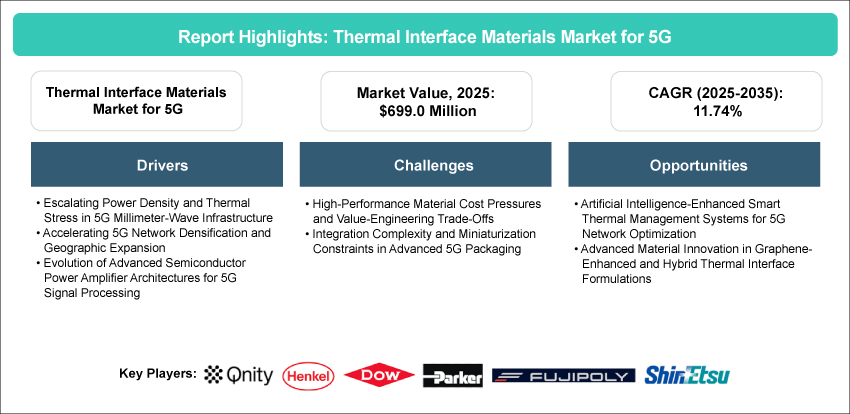
The thermal interface materials market for 5G is projected to grow from $699.0 million in 2025 to $2,122.0 million by 2035, at a CAGR of 11.74%. The growth is driven by the rapid expansion of 5G network infrastructure, increasing deployment of high-power base stations, and rising demand for efficient heat dissipation across compact and thermally stressed 5G devices and subsystems. As 5G systems operate at higher speeds and power levels than earlier wireless generations, effective thermal interface materials are becoming essential to prevent overheating, maintain signal stability, and support long-term equipment reliability. In addition, ongoing material innovation, including thermally conductive filler-enhanced polymers, flexible interface solutions, and advanced formulations optimized for miniaturized electronics, is further strengthening market development.
Rising investments in 5G infrastructure, semiconductor packaging, and telecom equipment manufacturing are significantly boosting the adoption of thermal interface materials across global markets. Among applications, 5G base stations represent the leading segment, supported by their continuous high-power operation, significant thermal loads, and need for durable, high-conductivity materials in outdoor and semi-outdoor environments. On the product side, thermal gap pads lead the market because they provide a practical balance of thermal performance, mechanical compliance, electrical insulation, and ease of integration across a wide range of 5G hardware. Regionally, Asia-Pacific remains the dominant market, reflecting its large-scale 5G rollout, strong electronics manufacturing base, and concentration of telecom and semiconductor ecosystems.
However, the market faces challenges such as high-performance material cost pressures, value-engineering trade-offs, and integration complexity in increasingly miniaturized 5G packaging architectures. Advanced materials such as graphene-enhanced and phase-change formulations offer superior thermal performance, but their higher cost and processing requirements can limit broader adoption in price-sensitive segments. At the same time, packaging constraints, electrical insulation requirements, and thermal-mechanical stress across compact RF modules make material selection and integration more demanding. Despite these constraints, the competitive landscape remains dynamic, with manufacturers focusing on continuous material innovation, strategic collaboration with telecom and semiconductor companies, and expansion of scalable, quality-consistent production capabilities. As 5G infrastructure and high-performance connected devices continue to expand, the thermal interface materials market for 5G is expected to witness sustained growth, supported by the need for reliable, high-efficiency, and application-optimized thermal management solutions.
Introduction of the Thermal Interface Materials Market for 5G
The study conducted by BIS Research identifies the thermal interface materials market for 5G as a critical enabler of next-generation wireless infrastructure, semiconductor packaging, and high-performance electronic systems. Thermal interface materials play an essential role in managing the substantial heat generated by 5G hardware, including base stations, smartphones, and related telecom subsystems, by facilitating efficient heat transfer between heat-generating components and cooling structures. As 5G systems operate at higher frequencies, greater power densities, and tighter form factors than earlier wireless generations, the importance of reliable thermal management has increased significantly. Effective thermal interface materials help maintain device efficiency, reduce the risk of overheating, and support the long-term reliability of high-frequency communication equipment.
With advancements in material science, the market is evolving toward high-performance formulations that combine improved thermal conductivity, mechanical compliance, and compatibility with compact 5G hardware. Innovations such as graphene-enhanced compounds, advanced phase change materials, flexible gap pads, and intelligent thermal management integration are strengthening the role of thermal interface materials across increasingly demanding 5G applications. In addition, ongoing miniaturization of electronics and rising thermal stress in high-power radio-frequency systems are driving the need for more sophisticated materials that can perform reliably across diverse operating environments. As 5G infrastructure deployment accelerates globally, the market is expected to witness strong growth, supported by continuous telecom investment, higher semiconductor packaging requirements, and sustained innovation in thermal solutions.
Market Introduction
The thermal interface materials market for 5G is becoming a foundational component of modern telecommunications and advanced electronics ecosystems, driven by the growing need for efficient thermal control in high-speed, high-power, and miniaturized 5G systems. As global deployment of 5G networks expands and demand for compatible hardware rises, thermal interface materials are increasingly being adopted across infrastructure and device categories to maintain thermal stability and ensure uninterrupted performance. Telecommunications companies are investing heavily in next-generation network infrastructure, while device and component manufacturers are seeking advanced materials that provide both strong heat dissipation and mechanical reliability.
Rapid advancements in material engineering and performance optimization are enhancing the functionality of thermal interface solutions, enabling improved heat dissipation without compromising electrical insulation, manufacturability, or form factor requirements. The market is also benefiting from a growing shift toward flexible and conformable materials that can adapt to irregular surfaces in compact device designs, along with increasing interest in solutions that simplify assembly and reduce overall system weight. These developments are particularly relevant in applications such as 5G base stations, smartphones, routers, and servers, where sustained power loads and thermal stress can directly influence operational stability. With continued innovation, broader 5G coverage, and increasing adoption across connected technologies, the thermal interface materials market for 5G is expected to play a vital role in the future of thermal management for wireless infrastructure and advanced electronics.
Industrial Impact
The thermal interface materials market for 5G is exerting a significant industrial impact, reshaping the telecommunications equipment, semiconductor packaging, and electronics manufacturing sectors through improvements in heat dissipation, thermal reliability, and system performance. As 5G hardware operates at higher power densities and under more demanding thermal conditions than previous wireless generations, thermal interface materials are becoming increasingly important in supporting stable performance across base stations, smartphones, and computing-related 5G equipment. These materials enable efficient heat transfer, reduce thermal resistance, and help extend the operational life of critical components exposed to sustained thermal stress.
The integration of advanced formulations such as nanomaterial-enhanced TIMs, graphene-based composites, phase change materials, and intelligent thermal management concepts is driving demand for more specialized and higher-value thermal solutions. These advancements are improving cooling efficiency, enabling better thermal control in miniaturized electronics, and supporting the evolution of high-performance 5G semiconductor and RF architectures. At the same time, the market is influencing collaboration across the broader value chain, from raw material suppliers and material formulators to component integrators and telecom OEMs, as qualification, co-development, and manufacturing readiness become more important in delivering commercially viable 5G thermal solutions.
As telecom operators and device manufacturers prioritize network performance, equipment reliability, and long-term energy efficiency, the thermal interface materials market for 5G is expected to remain a key enabling layer within the broader 5G infrastructure ecosystem. The surrounding industrial landscape is also evolving rapidly, supported by global 5G rollout, semiconductor innovation, packaging miniaturization, and growing investment in advanced thermal material research. This is reinforcing the position of thermal interface materials as an essential component in enabling scalable, durable, and thermally optimized 5G systems.
Market Segmentation
Segmentation 1: by Application
• 5G Smartphones
• 5G Base Stations
• Others (Routers and Servers)
5G Base Stations to Maintain Dominance in the Global Thermal Interface Materials Market for 5G (by Application)
In the global thermal interface materials market for 5G, the 5G base stations segment is projected to dominate, growing from $409.4 million in 2025 to $1,182.1 million by 2035, at a CAGR of 11.19%, driven by continuous high-power operation, substantial thermal loads, and the need for durable, high-conductivity materials across outdoor and semi-outdoor telecom infrastructure. Massive multiple-input multiple-output antennas, power amplifiers, and radio frequency modules within base stations generate significant heat during sustained data transmission, making efficient thermal management essential for stable network performance. Meanwhile, the others segment, comprising routers and servers, is expected to be the fastest-growing, with a CAGR of 13.46%, increasing from $63.4 million in 2025 to $224.2 million by 2035, supported by growing deployment of edge computing platforms, enterprise routers, switches, and data-processing systems that require sophisticated thermal solutions under sustained high-power operation.
The 5G smartphones segment in the global thermal interface materials market for 5G is also witnessing strong growth, expanding at a CAGR of 12.21% from $226.2 million in 2025 to $715.7 million by 2035, driven by increasing integration of advanced processors, modem chipsets, and radio frequency components in compact device form factors. Together, these application segments are shaping the evolution of the market, reflecting rising demand for efficient heat dissipation, improved reliability, and advanced thermal control across the 5G hardware ecosystem.
Segmentation 2: by Product
• Thermal Greases
• Thermal Gap Pads
• Thermal Gels
• Phase Change Materials
• Thermal Tapes
• Graphite Sheets
• Thermal Gap Fillers
• Others (Graphene and Carbon Fiber TIM)
Thermal Gap Pads to Maintain Dominance in the Global Thermal Interface Materials Market for 5G (by Product)
In the global thermal interface materials market for 5G, the thermal gap pads segment is projected to dominate, growing from $201.9 million in 2025 to $642.5 million by 2035, at a CAGR of 12.27%, driven by their practical balance between thermal performance, mechanical compliance, electrical insulation, and ease of integration across a wide range of 5G hardware. These materials are especially suitable for bridging uneven surfaces and variable interface gaps in densely packed base station and device assemblies, while also simplifying manufacturing and rework processes.
Meanwhile, the others segment, which includes graphene and carbon fiber thermal interface materials, is expected to be the fastest-growing, with a CAGR of 14.52%, increasing from $19.3 million in 2025 to $74.7 million by 2035, supported by the shift toward advanced high-conductivity materials as 5G systems evolve toward higher performance and greater miniaturization requirements. Thermal gels are also witnessing strong growth, expanding at a CAGR of 13.24% from $115.3 million in 2025 to $399.8 million by 2035, driven by their stable interface behavior, reduced pump-out tendency, and suitability for applications exposed to thermal cycling and vibration.
In addition, thermal greases are projected to grow from $112.3 million in 2025 to $319.8 million by 2035, at a CAGR of 11.03%, while phase change materials are expected to rise from $73.2 million to $218.9 million at a CAGR of 11.58%. Graphite sheets and thermal gap fillers are also expanding steadily, reaching $216.0 million and $162.3 million by 2035, respectively. Together, these product segments are shaping the development of the market, reflecting continued innovation in heat dissipation, material performance, and thermal reliability for next-generation 5G systems.
Segmentation 3: by Region
• North America: U.S., Canada, and Mexico
• Europe: Germany, France, U.K., Italy, and Rest-of-Europe
• Asia-Pacific: China, Japan, South Korea, India, Taiwan, and Rest-of-Asia-Pacific
• Rest-of-the-World: South America, the Middle East, and Africa
Asia-Pacific to Maintain Dominance in the Global Thermal Interface Materials Market for 5G (by Region)
In the global thermal interface materials market for 5G, Asia-Pacific is projected to maintain its dominant position, growing from $524.6 million in 2025 to $1,631.6 million by 2035, at a CAGR of 12.02%, driven by large-scale 5G rollout, leadership in electronics manufacturing, and strong concentration of telecom, semiconductor, and device production ecosystems across the region. China, South Korea, Japan, and India continue to support substantial demand for high-performance thermal solutions through aggressive network deployment and high-volume manufacturing of 5G hardware. Meanwhile, North America is expected to grow from $84.7 million in 2025 to $246.2 million by 2035, at a CAGR of 11.26%, supported by continued investment in telecom infrastructure, advanced semiconductor packaging, and performance-driven adoption of specialized thermal materials. Europe is projected to rise from $70.0 million in 2025 to $193.1 million by 2035, at a CAGR of 10.68%, driven by steady 5G expansion and increasing requirements for reliable thermal performance in telecom equipment and devices. The rest-of-the-world segment is also expanding steadily, increasing from $19.7 million in 2025 to $51.1 million by 2035, at a CAGR of 10.01%, supported by gradual infrastructure buildout and broader adoption of 5G-enabled systems. Together, these regional markets are shaping the global thermal interface materials market for 5G, reflecting differences in manufacturing strength, rollout intensity, and technology adoption across geographies.
Demand: Drivers, Limitations, and Opportunities
Market Demand Drivers: Escalating Power Density and 5G Infrastructure Expansion
The thermal interface materials market for 5G has been experiencing strong demand growth, driven by the need for efficient heat dissipation across high-frequency, high-power, and compact 5G hardware. One of the primary drivers is the escalating power density and thermal stress in 5G millimeter-wave infrastructure, where massive MIMO antennas, power amplifiers, and radio frequency modules generate substantially greater heat than previous wireless generations. As 5G base stations and advanced semiconductor packages become more thermally constrained, effective thermal interface materials are becoming essential for maintaining signal stability, equipment efficiency, and long-term reliability. In parallel, accelerating 5G network densification and geographic expansion are increasing the deployment of thermally stressed network equipment across urban, outdoor, and distributed installations. The market is also benefiting from the evolution of advanced semiconductor power amplifier architectures for 5G signal processing, which require higher-performance thermal materials capable of supporting miniaturization, electrical insulation, and tighter packaging tolerances. As telecom and electronics manufacturers continue to prioritize thermal performance, durability, and compact design, demand for thermal interface materials is expected to remain strong across global 5G applications.
Market Challenges: Cost Pressures and Integration Complexity
The thermal interface materials market for 5G faces a series of structural and technical challenges that could affect its long-term scalability and adoption. A key challenge is the cost pressure associated with high-performance materials, particularly graphene-enhanced and advanced phase-change formulations, which require premium raw materials, specialized processing, and tighter quality control. This creates value-engineering trade-offs for equipment manufacturers, especially in cost-sensitive segments where pricing pressure remains high. Another major challenge is integration complexity in advanced 5G packaging, where thermal materials must balance high conductivity, electrical insulation, minimal bond-line thickness, and compatibility with compact RF modules and semiconductor packages. As device miniaturization continues and packaging becomes more complex, coefficient-of-thermal-expansion mismatches, thermal cycling stress, and signal integrity considerations make thermal material selection and application more difficult. Together, these challenges highlight the need for cost optimization, application-specific formulation development, and stronger co-engineering across telecom and semiconductor value chains.
Market Opportunities: AI-Enhanced Thermal Management and Advanced Material Innovation
The growing emphasis on intelligent thermal control and next-generation material performance presents significant opportunities for the thermal interface materials market for 5G. One of the strongest opportunities lies in artificial intelligence-enhanced smart thermal management systems for 5G network optimization, where real-time monitoring, predictive thermal modeling, and dynamic heat-management strategies can improve reliability and reduce cooling inefficiencies across distributed 5G infrastructure. In addition, advanced material innovation in graphene-enhanced and hybrid thermal interface formulations is opening new commercial pathways as power densities increase and miniaturization demands intensify. Graphene and carbon nanotube-based materials offer substantially improved conductivity over conventional solutions and are increasingly relevant for higher-performance telecom and semiconductor applications. As these advanced materials move from premium niche solutions toward broader commercialization, they are expected to create differentiated growth opportunities for suppliers that can combine material innovation, manufacturing scale, and telecom-specific performance validation.
Analyst View
According to Dhrubajyoti Narayan, Principal Analyst at BIS Research, “The thermal interface materials market for 5G is poised for sustained growth, driven by the increasing thermal complexity of 5G infrastructure and the rising demand for materials that can support high power density, miniaturization, and long-term reliability. Market participants are actively focusing on material innovation, strategic collaboration with telecom and semiconductor companies, and scalable manufacturing to strengthen their competitive positions. At the same time, challenges such as material cost pressures and integration constraints continue to influence adoption. As 5G deployment accelerates globally, thermal interface materials are expected to become an increasingly critical enabling layer for efficient, reliable, and application-optimized thermal management across telecom and connected electronics ecosystems.”
Thermal Interface Materials Market for 5G - A Global and Regional Analysis
Focus on Application, Product, and Country-Level Analysis - Analysis and Forecast, 2025-2035
Frequently Asked Questions
Ans: Thermal interface materials are advanced materials used to improve heat transfer between heat-generating components and cooling structures in 5G hardware. They are essential for maintaining thermal stability, performance efficiency, and long-term reliability across applications such as base stations, smartphones, routers, servers, and semiconductor packages.
Ans: Several trends are shaping the thermal interface materials market for 5G. These include accelerated migration toward advanced nanomaterial-enhanced thermal interface materials, artificial intelligence-driven intelligent thermal management systems integration, and rising performance requirements caused by electronics miniaturization and extreme power density.
Ans: Asia-Pacific leads the market, supported by large-scale 5G rollout, strong electronics manufacturing capacity, and concentration of telecom and semiconductor ecosystems. North America and Europe also represent important markets, while Rest-of-the-World remains smaller but steadily expanding.
Ans: The unique selling proposition of the thermal interface materials market for 5G report is its comprehensive analysis of the thermal interface materials market for 5G, with a strong focus on application trends, product evolution, market dynamics, regional outlook, and competitive benchmarking. It highlights how advanced thermal materials are enabling better heat dissipation, reliability, and integration across next-generation 5G systems while also addressing cost and packaging constraints.
Ans: This report is valuable for thermal material manufacturers, telecom equipment makers, semiconductor companies, device manufacturers, component integrators, investors, and stakeholders seeking opportunities in advanced 5G infrastructure and electronics thermal management. It is also relevant for organizations focused on material innovation, packaging performance, and next-generation wireless hardware development.