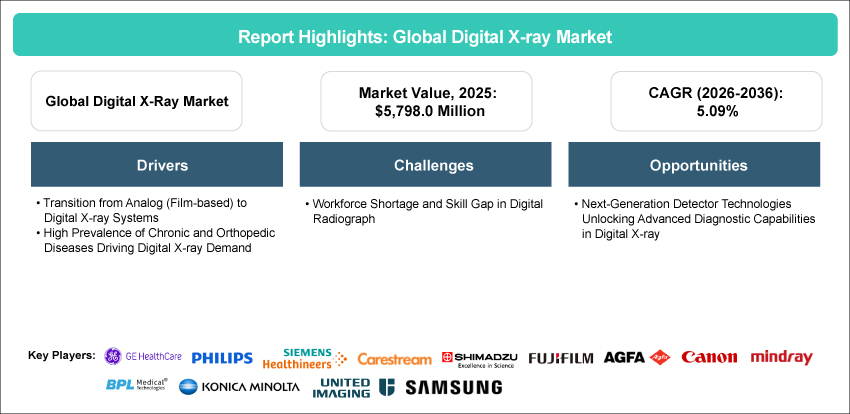
A quick peek into the report
Table of Contents
1.1 Market Overview and Ecosystem
1.2 Market Trends
1.2.1 Impact Analysis
1.2.2 Increasing Launch of Portable Digital X-ray Systems
1.3 Technological Advancements
1.3.1 Flat-Panel Detector (FPD) Innovation
1.3.2 Dose Optimization and Radiation Safety
1.4 Regulatory Landscape
1.4.1 North America
1.4.1.1 U.S.
1.4.1.2 Canada
1.4.2 Europe
1.4.2.1 EU Countries
1.4.2.2 U.K.
1.4.3 Asia-Pacific
1.4.3.1 Japan
1.4.3.2 China
1.4.3.3 India
1.4.4 Latin America
1.4.4.1 Brazil
1.4.4.2 Mexico
1.4.5 Middle East and Africa
1.4.5.1 KSA
1.4.5.2 South Africa
1.5 Supply Chain Analysis
1.6 Market Dynamics
1.6.1 Drivers, Challenges, and Opportunities: Current and Future Impact Assessment
1.6.2 Market Drivers
1.6.2.1 Transition from Analog (Film-based) to Digital X-ray Systems
1.6.2.2 High Prevalence of Chronic and Orthopedic Diseases Driving Digital X-ray Demand
1.6.3 Market Challenges
1.6.3.1 Workforce Shortage and Skill Gap in Digital Radiograph
1.6.4 Market Opportunities
1.6.4.1 Next-Generation Detector Technologies Unlocking Advanced Diagnostic Capabilities in Digital X-ray
2.1 Overview
2.1.1 Fixed Digital X-ray
2.1.2 Mobile Digital X-ray
3.1 Overview
3.1.1 Digital Radiography
3.1.2 Computed Radiography
4.1 Overview
4.1.1 New Digital X-ray System
4.1.2 Retrofit Digital X-ray System
5.1 Overview
5.1.1 Orthopedic Imaging
5.1.2 Chest Imaging
5.1.3 Dental Imaging
5.1.4 Others
6.1 Overview
6.1.1 Hospitals
6.1.2 Orthopedic and Specialty Centers
6.1.3 Diagnostics Imaging Centers
6.1.4 Other End Users
7.1 Global Summary
7.2 North America
7.2.1 Regional Overview
7.2.2 Driving Factors for Market Growth
7.2.3 Factors Challenging the Market
7.2.4 Market Sizing and Forecast
7.2.4.1 U.S.
7.2.4.1.1 Country Overview
7.2.4.1.2 Driving Factors for Market Growth
7.2.4.1.3 Factors Challenging the Market
7.2.4.1.4 Market Sizing and Forecast
7.2.4.2 Canada
7.2.4.2.1 Country Overview
7.2.4.2.2 Driving Factors for Market Growth
7.2.4.2.3 Factors Challenging the Market
7.2.4.2.4 Market Sizing and Forecast
7.4 Europe
7.4.1 Regional Overview
7.4.2 Driving Factors for Market Growth
7.4.3 Factors Challenging the Market
7.4.4 Market Sizing and Forecast
7.4.4.1 U.K.
7.4.4.1.1 Country Overview
7.4.4.1.2 Driving Factors for Market Growth
7.4.4.1.3 Factors Challenging the Market
7.4.4.1.4 Market Sizing and Forecast
7.4.4.2 Germany
7.4.4.2.1 Country Overview
7.4.4.2.2 Driving Factors for Market Growth
7.4.4.2.3 Factors Challenging the Market
7.4.4.2.4 Market Sizing and Forecast
7.4.4.3 France
7.4.4.3.1 Country Overview
7.4.4.3.2 Driving Factors for Market Growth
7.4.4.3.3 Factors Challenging the Market
7.4.4.3.4 Market Sizing and Forecast
7.4.4.4 Italy
7.4.4.4.1 Country Overview
7.4.4.4.2 Driving Factors for Market Growth
7.4.4.4.3 Factors Challenging the Market
7.4.4.4.4 Market Sizing and Forecast
7.4.4.5 Spain
7.4.4.5.1 Country Overview
7.4.4.5.2 Driving Factors for Market Growth
7.4.4.5.3 Factors Challenging the Market
7.4.4.5.4 Market Sizing and Forecast
7.4.4.6 Rest-of-the- Europe
7.4.4.6.1 Country Overview
7.4.4.6.2 Driving Factors for Market Growth
7.4.4.6.3 Factors Challenging the Market
7.4.4.6.4 Market Sizing and Forecast
7.5 Asia-Pacific
7.5.1 Regional Overview
7.5.2 Driving Factors for Market Growth
7.5.3 Factors Challenging the Market
7.5.4 Market Sizing and Forecast
7.5.4.1 China
7.5.4.1.1 Country Overview
7.5.4.1.2 Driving Factors for Market Growth
7.5.4.1.3 Factors Challenging the Market
7.5.4.1.4 Market Sizing and Forecast
7.5.4.2 Japan
7.5.4.2.1 Country Overview
7.5.4.2.2 Driving Factors for Market Growth
7.5.4.2.3 Factors Challenging the Market
7.5.4.2.4 Market Sizing and Forecast
7.5.4.3 India
7.5.4.3.1 Country Overview
7.5.4.3.2 Driving Factors for Market Growth
7.5.4.3.3 Factors Challenging the Market
7.5.4.3.4 Market Sizing and Forecast
7.5.4.4 Australia
7.5.4.4.1 Country Overview
7.5.4.4.2 Driving Factors for Market Growth
7.5.4.4.3 Factors Challenging the Market
7.5.4.4.4 Market Sizing and Forecast
7.5.4.5 South Korea
7.5.4.5.1 Country Overview
7.5.4.5.2 Driving Factors for Market Growth
7.5.4.5.3 Factors Challenging the Market
7.5.4.5.4 Market Sizing and Forecast
7.5.4.6 Rest-of-the-Asia Pacific
7.5.4.6.1 Country Overview
7.5.4.6.2 Driving Factors for Market Growth
7.5.4.6.3 Factors Challenging the Market
7.5.4.6.4 Market Sizing and Forecast
7.6 Latin America
7.6.1 Regional Overview
7.6.2 Driving Factors for Market Growth
7.6.3 Factors Challenging the Market
7.6.4 Market Sizing and Forecast
7.6.4.1 Brazil
7.6.4.1.1 Country Overview
7.6.4.1.2 Driving Factors for Market Growth
7.6.4.1.3 Factors Challenging the Market
7.6.4.1.4 Market Sizing and Forecast
7.6.4.2 Mexico
7.6.4.2.1 Country Overview
7.6.4.2.2 Driving Factors for Market Growth
7.6.4.2.3 Factors Challenging the Market
7.6.4.2.4 Market Sizing and Forecast
7.6.4.3 Rest-of-Latin America
7.6.4.3.1 Country Overview
7.6.4.3.2 Driving Factors for Market Growth
7.6.4.3.3 Factors Challenging the Market
7.6.4.3.4 Market Sizing and Forecast
7.7 Middle East and Africa
7.7.1 Regional Overview
7.7.2 Driving Factors for Market Growth
7.7.3 Factors Challenging the Market
7.7.4 Market Sizing and Forecast
7.7.4.1 KSA
7.7.4.1.1 Regional Overview
7.7.4.1.2 Driving Factors for Market Growth
7.7.4.1.3 Factors Challenging the Market
7.7.4.1.4 Market Sizing and Forecast
7.7.4.2 U.A.E.
7.7.4.2.1 Regional Overview
7.7.4.2.2 Driving Factors for Market Growth
7.7.4.2.3 Factors Challenging the Market
7.7.4.2.4 Market Sizing and Forecast
7.7.4.3 South Africa
7.7.4.3.1 Regional Overview
7.7.4.3.2 Driving Factors for Market Growth
7.7.4.3.3 Factors Challenging the Market
7.7.4.3.4 Market Sizing and Forecast
7.7.4.4 Rest-of-Middle East and Africa
7.7.4.4.1 Regional Overview
7.7.4.4.2 Driving Factors for Market Growth
7.7.4.4.3 Factors Challenging the Market
7.7.4.4.4 Market Sizing and Forecast
8.1 Global Digital X-ray Market, Key Strategies and Developments, February 2022-March 2026
8.2 Key Developments Analysis (by Company), January 2023-March 2026
8.3 Company Profiles
8.3.1 GE HealthCare
8.3.1.1 Overview
8.3.1.2 Top Products/Product Portfolio
8.3.1.3 Top Competitors
8.3.1.4 Target Customers
8.3.1.5 Key Personnel
8.3.1.6 Analyst View
8.3.2 Siemens Healthineers AG
8.3.2.1 Overview
8.3.2.2 Top Products/Product Portfolio
8.3.2.3 Top Competitors
8.3.2.4 Target Customers
8.3.2.5 Key Personnel
8.3.2.6 Analyst View
8.3.3 Koninklijke Philips N.V.
8.3.3.1 Overview
8.3.3.2 Top Products/Product Portfolio
8.3.3.3 Top Competitors
8.3.3.4 Target Customers
8.3.3.5 Key Personnel
8.3.3.6 Analyst View
8.3.4 FUJIFILM Corporation
8.3.4.1 Overview
8.3.4.2 Top Products/Product Portfolio
8.3.4.3 Top Competitors
8.3.4.4 Target Customers
8.3.4.5 Key Personnel
8.3.4.6 Analyst View
8.3.5 Canon Inc.
8.3.5.1 Overview
8.3.5.2 Top Products/Product Portfolio
8.3.5.3 Top Competitors
8.3.5.4 Target Customers
8.3.5.5 Key Personnel
8.3.5.6 Analyst View
8.3.6 Shenzhen Mindray Bio-Medical Electronics Co., Ltd.
8.3.6.1 Overview
8.3.6.2 Top Products/Product Portfolio
8.3.6.3 Top Competitors
8.3.6.4 Target Customers
8.3.6.5 Key Personnel
8.3.6.6 Analyst View
8.3.7 Shimadzu Corporation
8.3.7.1 Overview
8.3.7.2 Top Products/Product Portfolio
8.3.7.3 Top Competitors
8.3.7.4 Target Customers
8.3.7.5 Key Personnel
8.3.7.6 Analyst View
8.3.8 Konica Minolta, Inc.
8.3.8.1 Overview
8.3.8.2 Top Products/Product Portfolio
8.3.8.3 Top Competitors
8.3.8.4 Target Customers
8.3.8.5 Key Personnel
8.3.8.6 Analyst View
8.3.9 Agfa-Gevaert Group
8.3.9.1 Overview
8.3.9.2 Top Products/Product Portfolio
8.3.9.3 Top Competitors
8.3.9.4 Target Customers
8.3.9.5 Key Personnel
8.3.9.6 Analyst View
8.3.10 SAMSUNG
8.3.10.1 Overview
8.3.10.2 Top Products/Product Portfolio
8.3.10.3 Top Competitors
8.3.10.4 Target Customers
8.3.10.5 Key Personnel
8.3.10.6 Analyst View
8.3.11 Carestream Health
8.3.11.1 Overview
8.3.11.2 Top Products/Product Portfolio
8.3.11.3 Top Competitors
8.3.11.4 Target Customers
8.3.11.5 Key Personnel
8.3.11.6 Analyst View
8.3.12 BPL Medical Technologies
8.3.12.1 Overview
8.3.12.2 Top Products/Product Portfolio
8.3.12.3 Top Competitors
8.3.12.4 Target Customers
8.3.12.5 Key Personnel
8.3.12.6 Analyst View
8.3.13 OXOS Medical
8.3.13.1 Overview
8.3.13.2 Top Products/Product Portfolio
8.3.13.3 Top Competitors
8.3.13.4 Target Customers
8.3.13.5 Key Personnel
8.3.13.6 Analyst View
8.3.14 Shanghai United Imaging Healthcare Co., Ltd.
8.3.14.1 Overview
8.3.14.2 Top Products/Product Portfolio
8.3.14.3 Top Competitors
8.3.14.4 Target Customers
8.3.14.5 Key Personnel
8.3.14.6 Analyst View
8.3.15 Acteon
8.3.15.1 Overview
8.3.15.2 Top Products/Product Portfolio
8.3.15.3 Top Competitors
8.3.15.4 Target Customers
8.3.15.5 Key Personnel
8.3.15.6 Analyst View
9.1 Data Sources
9.1.1 Primary Data Sources
9.1.2 Secondary Data Sources
9.1.3 Data Triangulation
9.2 Market Estimation and Forecast
Table 1: Market Snapshot
Table 2: Examples of Portable X-ray Systems launched in year 2023-2025
Table 3: Global Digital X-ray Market (by Region), $Million, 2024-2036
Table 4: Global Digital X-ray Market (by Technology), $Million, 2024-2036
Table 5: Global Digital X-ray Market (Portability), $Million, 2024-2036
Table 6: Global Digital X-ray Market (Product Type), $Million, 2024-2036
Table 7: Global Digital X-ray Market (Application), $Million, 2024-2036
Table 8: Global Digital X-ray Market (End User), $Million, 2024-2036
Table 9: North America Digital X-ray Market (by Country), $Million, 2024-2036
Table 10: North America Digital X-ray Market (by Technology), $Million, 2024-2036
Table 11: North America Digital X-ray Market (Portability), $Million, 2024-2036
Table 12: North America Digital X-ray Market (Product Type), $Million, 2024-2036
Table 13: North America Digital X-ray Market (Application), $Million, 2024-2036
Table 14: North America Digital X-ray Market (End User), $Million, 2024-2036
Table 15: U.S. Digital X-ray Market (by Technology), $Million, 2024-2036
Table 16: U.S. Digital X-ray Market (Portability), $Million, 2024-2036
Table 17: U.S. Digital X-ray Market (Product Type), $Million, 2024-2036
Table 18: U.S. Digital X-ray Market (Application), $Million, 2024-2036
Table 19: U.S. Digital X-ray Market (End User), $Million, 2024-2036
Table 20: Canada Digital X-ray Market (by Technology), $Million, 2024-2036
Table 21: Canada Digital X-ray Market (Portability), $Million, 2024-2036
Table 22: Canada Digital X-ray Market (Product Type), $Million, 2024-2036
Table 23: Canada Digital X-ray Market (Application), $Million, 2024-2036
Table 24: Canada Digital X-ray Market (End User), $Million, 2024-2036
Table 25: Europe Digital X-ray Market (by Country), $Million, 2024-2036
Table 26: Europe Digital X-ray Market (by Technology), $Million, 2024-2036
Table 27: Europe Digital X-ray Market (Portability), $Million, 2024-2036
Table 28: Europe Digital X-ray Market (Product Type), $Million, 2024-2036
Table 29: Europe Digital X-ray Market (Application), $Million, 2024-2036
Table 30: Europe Digital X-ray Market (End User), $Million, 2024-2036
Table 31: U.K. Digital X-ray Market (by Technology), $Million, 2024-2036
Table 32: U.K. Digital X-ray Market (Portability), $Million, 2024-2036
Table 33: U.K. Digital X-ray Market (Product Type), $Million, 2024-2036
Table 34: U.K. Digital X-ray Market (Application), $Million, 2024-2036
Table 35: U.K. Digital X-ray Market (End User), $Million, 2024-2036
Table 36: Germany Digital X-ray Market (by Technology), $Million, 2024-2036
Table 37: Germany Digital X-ray Market (Portability), $Million, 2024-2036
Table 38: Germany Digital X-ray Market (Product Type), $Million, 2024-2036
Table 39: Germany Digital X-ray Market (Application), $Million, 2024-2036
Table 40: Germany Digital X-ray Market (End User), $Million, 2024-2036
Table 41: France Digital X-ray Market (by Technology), $Million, 2024-2036
Table 42: France Digital X-ray Market (Portability), $Million, 2024-2036
Table 43: France Digital X-ray Market (Product Type), $Million, 2024-2036
Table 44: France Digital X-ray Market (Application), $Million, 2024-2036
Table 45: France Digital X-ray Market (End User), $Million, 2024-2036
Table 46: Italy Digital X-ray Market (by Technology), $Million, 2024-2036
Table 47: Italy Digital X-ray Market (Portability), $Million, 2024-2036
Table 48: Italy Digital X-ray Market (Product Type), $Million, 2024-2036
Table 49: Italy Digital X-ray Market (Application), $Million, 2024-2036
Table 50: Italy Digital X-ray Market (End User), $Million, 2024-2036
Table 51: Spain Digital X-ray Market (by Technology), $Million, 2024-2036
Table 52: Spain Digital X-ray Market (Portability), $Million, 2024-2036
Table 53: Spain Digital X-ray Market (Product Type), $Million, 2024-2036
Table 54: Spain Digital X-ray Market (Application), $Million, 2024-2036
Table 55: Spain Digital X-ray Market (End User), $Million, 2024-2036
Table 56: Rest-of-Europe Digital X-ray Market (by Technology), $Million, 2024-2036
Table 57: Rest-of-Europe Digital X-ray Market (Portability), $Million, 2024-2036
Table 58: Rest-of-Europe Digital X-ray Market (Product Type), $Million, 2024-2036
Table 59: Rest-of-Europe Digital X-ray Market (Application), $Million, 2024-2036
Table 60: Rest-of-Europe Digital X-ray Market (End User), $Million, 2024-2036
Table 61: Asia-Pacific Digital X-ray Market (by Country), $Million, 2024-2036
Table 62: Asia-Pacific Digital X-ray Market (by Technology), $Million, 2024-2036
Table 63: Asia-Pacific Digital X-ray Market (Portability), $Million, 2024-2036
Table 64: Asia-Pacific Digital X-ray Market (Product Type), $Million, 2024-2036
Table 65: Asia-Pacific Digital X-ray Market (Application), $Million, 2024-2036
Table 66: Asia-Pacific Digital X-ray Market (End User), $Million, 2024-2036
Table 67: China Digital X-ray Market (by Technology), $Million, 2024-2036
Table 68: China Digital X-ray Market (Portability), $Million, 2024-2036
Table 69: China Digital X-ray Market (Product Type), $Million, 2024-2036
Table 70: China Digital X-ray Market (Application), $Million, 2024-2036
Table 71: China Digital X-ray Market (End User), $Million, 2024-2036
Table 72: Japan Digital X-ray Market (by Technology), $Million, 2024-2036
Table 73: Japan Digital X-ray Market (Portability), $Million, 2024-2036
Table 74: Japan Digital X-ray Market (Product Type), $Million, 2024-2036
Table 75: Japan Digital X-ray Market (Application), $Million, 2024-2036
Table 76: Japan Digital X-ray Market (End User), $Million, 2024-2036
Table 77: India Digital X-ray Market (by Technology), $Million, 2024-2036
Table 78: India Digital X-ray Market (Portability), $Million, 2024-2036
Table 79: India Digital X-ray Market (Product Type), $Million, 2024-2036
Table 80: India Digital X-ray Market (Application), $Million, 2024-2036
Table 81: India Digital X-ray Market (End User), $Million, 2024-2036
Table 82: Australia Digital X-ray Market (by Technology), $Million, 2024-2036
Table 83: Australia Digital X-ray Market (Portability), $Million, 2024-2036
Table 84: Australia Digital X-ray Market (Product Type), $Million, 2024-2036
Table 85: Australia Digital X-ray Market (Application), $Million, 2024-2036
Table 86: Australia Digital X-ray Market (End User), $Million, 2024-2036
Table 87: South Korea Digital X-ray Market (by Technology), $Million, 2024-2036
Table 88: South Korea Digital X-ray Market (Portability), $Million, 2024-2036
Table 89: South Korea Digital X-ray Market (Product Type), $Million, 2024-2036
Table 90: South Korea Digital X-ray Market (Application), $Million, 2024-2036
Table 91: South Korea Digital X-ray Market (End User), $Million, 2024-2036
Table 92: Rest-of-Asia-Pacific Digital X-ray Market (by Technology), $Million, 2024-2036
Table 93: Rest-of-Asia-Pacific Digital X-ray Market (Portability), $Million, 2024-2036
Table 94: Rest-of-Asia-Pacific Digital X-ray Market (Product Type), $Million, 2024-2036
Table 95: Rest-of-Asia-Pacific Digital X-ray Market (Application), $Million, 2024-2036
Table 96: Rest-of-Asia-Pacific Digital X-ray Market (End User), $Million, 2024-2036
Table 97: Latin America Digital X-ray Market (by Country), $Million, 2024-2036
Table 98: Latin America Digital X-ray Market (by Technology), $Million, 2024-2036
Table 99: Latin America Digital X-ray Market (Portability), $Million, 2024-2036
Table 100: Latin America Digital X-ray Market (Product Type), $Million, 2024-2036
Table 101: Latin America Digital X-ray Market (Application), $Million, 2024-2036
Table 102: Latin America Digital X-ray Market (End User), $Million, 2024-2036
Table 103: Brazil Digital X-ray Market (by Technology), $Million, 2024-2036
Table 104: Brazil Digital X-ray Market (Portability), $Million, 2024-2036
Table 105: Brazil Digital X-ray Market (Product Type), $Million, 2024-2036
Table 106: Brazil Digital X-ray Market (Application), $Million, 2024-2036
Table 107: Brazil Digital X-ray Market (End User), $Million, 2024-2036
Table 108: Mexico Digital X-ray Market (by Technology), $Million, 2024-2036
Table 109: Mexico Digital X-ray Market (Portability), $Million, 2024-2036
Table 110: Mexico Digital X-ray Market (Product Type), $Million, 2024-2036
Table 111: Mexico Digital X-ray Market (Application), $Million, 2024-2036
Table 112: Mexico Digital X-ray Market (End User), $Million, 2024-2036
Table 113: Rest-of-Latin America Digital X-ray Market (by Technology), $Million, 2024-2036
Table 114: Rest-of-Latin America Digital X-ray Market (Portability), $Million, 2024-2036
Table 115: Rest-of-Latin America Digital X-ray Market (Product Type), $Million, 2024-2036
Table 116: Rest-of-Latin America Digital X-ray Market (Application), $Million, 2024-2036
Table 117: Rest-of-Latin America Digital X-ray Market (End User), $Million, 2024-2036
Table 118: Middle East and Africa Digital X-ray Market (by Country), $Million, 2024-2036
Table 119: Middle East and Africa Digital X-ray Market (by Technology), $Million, 2024-2036
Table 120: Middle East and Africa Digital X-ray Market (Portability), $Million, 2024-2036
Table 121: Middle East and Africa Digital X-ray Market (Product Type), $Million, 2024-2036
Table 122: Middle East and Africa Digital X-ray Market (Application), $Million, 2024-2036
Table 123: Middle East and Africa Digital X-ray Market (End User), $Million, 2024-2036
Table 124: KSA Digital X-ray Market (by Technology), $Million, 2024-2036
Table 125: KSA Digital X-ray Market (Portability), $Million, 2024-2036
Table 126: KSA Digital X-ray Market (Product Type), $Million, 2024-2036
Table 127: KSA Digital X-ray Market (Application), $Million, 2024-2036
Table 128: KSA Digital X-ray Market (End User), $Million, 2024-2036
Table 129: U.A.E. Digital X-ray Market (by Technology), $Million, 2024-2036
Table 130: U.A.E. Digital X-ray Market (Portability), $Million, 2024-2036
Table 131: U.A.E. Digital X-ray Market (Product Type), $Million, 2024-2036
Table 132: U.A.E. Digital X-ray Market (Application), $Million, 2024-2036
Table 133: U.A.E. Digital X-ray Market (End User), $Million, 2024-2036
Table 134: South Africa Digital X-ray Market (by Technology), $Million, 2024-2036
Table 135: South Africa Digital X-ray Market (Portability), $Million, 2024-2036
Table 136: South Africa Digital X-ray Market (Product Type), $Million, 2024-2036
Table 137: South Africa Digital X-ray Market (Application), $Million, 2024-2036
Table 138: South Africa Digital X-ray Market (End User), $Million, 2024-2036
Table 139: Rest-of-Middle East and Africa Digital X-ray Market (by Technology), $Million, 2024-2036
Table 140: Rest-of-Middle East and Africa Digital X-ray Market (Portability), $Million, 2024-2036
Table 141: Rest-of-Middle East and Africa Digital X-ray Market (Product Type), $Million, 2024-2036
Table 142: Rest-of-Middle East and Africa Digital X-ray Market (Application), $Million, 2024-2036
Table 143: Rest-of-Middle East and Africa Digital X-ray Market (End User), $Million, 2024-2036
Table 144: Global Digital X-ray Market, Key Strategies and Developments (by Company), Feb 2024-Feb 2026
Figure 1: Global Digital X-ray Market (by Scenario), $Million, 2025, 2026, and 2036
Figure 2: Global Digital X-ray Market, 2025 and 2036
Figure 3: Global Digital X-ray Market (by Country), $Million, 2025
Figure 4: Global Digital X-ray Market Snapshot
Figure 5: Global Digital X-ray Market, $Million, 2025 and 2036
Figure 6: Digital X-ray Market (by Portability), $Million, 2025, 2028, and 2036
Figure 7: Digital X-ray Market (by Technology), $Million, 2025, 2028, and 2036
Figure 8: Digital X-ray Market (by Product Type), $Million, 2025, 2028, and 2036
Figure 9: Digital X-ray Market (by Application), $Million, 2025, 2028, and 2036
Figure 10: Digital X-ray Market (by End User), $Million, 2025, 2030, and 2036
Figure 11: Supply Chain Analysis for the Global Digital X-ray Market
Figure 12: Global Digital X-ray Market (by Portability), $Million, 2025, 2030, and 2036
Figure 13: Global Digital X-ray Market (Fixed Digital X-ray), $Million, 2024-2036
Figure 14: Global Digital X-ray Market (Mobile Digital X-ray), $Million, 2024-2036
Figure 15: Global Digital X-ray Market (by Technology), $Million, 2025, 2030, and 2036
Figure 16: Global Digital X-ray Market (Digital Radiography), $Million, 2024-2036
Figure 17: Global Digital X-ray Market (Computed Radiography), $Million, 2024-2036
Figure 18: Global Digital X-ray Market (by Product Type), $Million, 2025, 2030, and 2036
Figure 19: Global Digital X-ray Market (New Digital X-ray System), $Million, 2024-2036
Figure 20: Global Digital X-ray Market (Retrofit Digital X-ray System), $Million, 2024-2036
Figure 21: Global Digital X-ray Market (by Application), $Million, 2025, 2029, and 2036
Figure 22: Global Digital X-ray Market (Orthopedic Imaging), $Million, 2024-2036
Figure 23: Global Digital X-ray Market (Chest Imaging), $Million, 2024-2036
Figure 24: Global Digital X-ray Market (Dental Imaging), $Million, 2024-2036
Figure 25: Global Digital X-ray Market (Others), $Million, 2024-2036
Figure 26: Global Digital X-ray Market (by End User), $Million, 2025, 2030, and 2036
Figure 27: Global Digital X-ray Market (Hospitals), $Million, 2024-2036
Figure 28: Global Digital X-ray Market (Orthopedic and Specialty Centers), $Million, 2024-2036
Figure 29: Global Digital X-ray Market (Diagnostics Imaging Centers), $Million, 2024-2036
Figure 30: Global Digital X-ray Market (Other End Users), $Million, 2024-2036
Figure 31: North America Digital X-ray Market, $Million, 2024-2036
Figure 32: U.S. Digital X-ray Market, $Million, 2024-2036
Figure 33: Canada Digital X-ray Market, $Million, 2024-2036
Figure 34: Europe Digital X-ray Market, $Million, 2024-2036
Figure 35: U.K. Digital X-ray Market, $Million, 2024-2036
Figure 36: Germany Digital X-ray Market, $Million, 2024-2036
Figure 37: France Digital X-ray Market, $Million, 2024-2036
Figure 38: Italy Digital X-ray Market, $Million, 2024-2036
Figure 39: Spain Digital X-ray Market, $Million, 2024-2036
Figure 40: Rest-of-Europe Digital X-ray Market, $Million, 2024-2036
Figure 41: Asia-Pacific Digital X-ray Market, $Million, 2024-2036
Figure 42: China Digital X-ray Market, $Million, 2024-2036
Figure 43: Japan Digital X-ray Market, $Million, 2024-2036
Figure 44: India Digital X-ray Market, $Million, 2024-2036
Figure 45: Australia Digital X-ray Market, $Million, 2024-2036
Figure 46: South Korea Digital X-ray Market, $Million, 2024-2036
Figure 47: Rest-of-Asia-Pacific Digital X-ray Market, $Million, 2024-2036
Figure 48: Latin America Digital X-ray Market, $Million, 2024-2036
Figure 49: Brazil Digital X-ray Market, $Million, 2024-2036
Figure 50: Mexico Digital X-ray Market, $Million, 2024-2036
Figure 51: Rest-of- Latin America Digital X-ray Market, $Million, 2024-2036
Figure 52: Middle East and Africa Digital X-ray Market, $Million, 2024-2036
Figure 53: KSA Digital X-ray Market, $Million, 2024-2036
Figure 54: U.A.E.Digital X-ray Market, $Million, 2024-2036
Figure 55: South Africa Digital X-ray Market, $Million, 2024-2036
Figure 56: Rest-of-Middle East and Africa Digital X-ray Market, $Million, 2024-2036
Figure 57: Global Digital X-ray Market, Key Strategies and Developments, February 2022-March 2026
Figure 58: Data Triangulation
Figure 59: Top-Down and Bottom-Up Approach
Figure 60: Assumptions and Limitations
Digital X-ray Market Report Coverage
|
Digital X-ray Market |
|||
|
Base Year |
2025 |
Market Size in 2025 |
$5,798.0 Million |
|
Forecast Period |
2026-2036 |
Value Projection and Estimation by 2036 |
$9,909.1 Million |
|
CAGR During Forecast Period |
5.09% |
Number of Pages |
217 |
|
Number of Tables |
144 |
Number of Figures |
60 |
Key Market Players and Competition Synopsis
The companies profiled have been selected based on inputs gathered from an analysis of company coverage, product portfolio, and market penetration.
Some prominent names established in this market are:
• GE HealthCare
• Siemens Healthineers AG
• Koninklijke Philips N.V.
• FUJIFILM Corporation
• Canon Inc.
• Shenzhen Mindray Bio-Medical Electronics Co., Ltd.
• Shimadzu Corporation
• Konica Minolta, Inc.
• Agfa-Gevaert Group
• SAMSUNG
• Carestream Health
• BPL Medical Technologies
• OXOS Medical
• Shanghai United Imaging Healthcare Co., Ltd.
• Acteon
How can this report add value to an organization?
Product/Innovation Strategy: The global digital X-ray market has been divided into several key segments, including portability, technology, product type, application, end user, and regional markets. By understanding demand across fixed and mobile digital X-ray systems, digital radiography and computed radiography technologies, new and retrofit systems, key imaging applications, and major healthcare end users, this report offers valuable insights for organizations looking to refine their product and innovation strategies.
Growth/Marketing Strategy: Digital imaging modernization, replacement of analog and computed radiography systems, mobile imaging adoption, healthcare infrastructure expansion, rural diagnostic access, detector upgrades, and hospital workflow digitization are anticipated to be central to the growth of the digital X-ray market. Key developments among digital X-ray manufacturers, detector suppliers, distributors, and healthcare providers are shaping adoption across hospitals, diagnostic imaging centers, specialty clinics, dental facilities, and decentralized care settings.
Competitive Strategy: The digital X-ray market is competitive and technology-driven, with established imaging companies and regional players competing through image quality, detector performance, workflow efficiency, mobility, dose optimization, AI-enabled software support, PACS/RIS integration, product reliability, service support, and retrofit upgrade pathways. Key market players are focusing on strengthening their position through advanced fixed and mobile platforms, next-generation detectors, compact system design, digital workflow integration, regional distribution, and solutions tailored to both premium and cost-sensitive healthcare environments.
Methodology
Key Considerations and Assumptions in Market Engineering and Validation
• Years from 2024 to 2036 have been considered for the global market size estimation; 2025 has been considered as the base year, and 2026 to 2036 as the forecast period.
• The scope of the report is based on comprehensive inputs from industry experts across various sectors, including hospitals, diagnostic imaging centers, orthopedic and specialty clinics, dental clinics, public-sector healthcare providers, digital X-ray system manufacturers, detector suppliers, medical imaging equipment distributors, service providers, and research institutions. The market contribution of digital X-ray is anticipated to grow steadily in the future, with projections based on historical analysis of available solutions.
• Revenues from companies have been sourced from their annual reports for FY2024 and FY2025. For private companies, revenue estimates have been derived from primary research inputs, funding history, market collaborations, and operational performance.
• The market has been mapped based on the existing digital X-ray products and systems. Key companies with significant offerings in digital X-ray systems have been identified and profiled in this report.
Primary Research
The primary sources involve industry experts from the healthcare industry and various stakeholders, such as digital X-ray system manufacturers, radiology department professionals, and academic and research institutions. Respondents such as CEOs, vice presidents, marketing directors, radiology professionals, and technology and innovation directors have been interviewed to obtain and verify both qualitative and quantitative aspects of this research study.
The key data points taken from the primary sources include:
• validation and triangulation of all the numbers and graphs
• validation of report segmentations and key qualitative findings
• understanding the competitive landscape and business model
• current and proposed production values of a product by market players
• validation of the numbers of different segments of the market in focus
• percentage split of individual markets for regional analysis
Secondary Research
Open Sources
• Certified publications, articles from recognized authors, white papers, directories, and major databases, among others
• Annual reports, SEC filings, and investors’ presentations of the leading market players
• Company websites and a detailed study of their product portfolio
• Gold standard magazines, journals, white papers, press releases, and news articles
• Paid databases
The key data points taken from the secondary sources include:
• segmentations and percentage shares
• data for market value
• key industry trends of the top players in the market
• qualitative insights into various aspects of the market, key trends, and emerging areas of innovation
• quantitative data for mathematical and statistical calculations
Global Digital X-ray Market Industry Overview

Introduction of the Digital X-ray Market
The global digital X-ray market, initially valued at $5,798.0 million in 2025, is projected to grow substantially, reaching $9,909.1 million by 2036, with a compound annual growth rate (CAGR) of 5.09% from 2026 to 2036.
The global digital X-ray market has been experiencing steady growth, driven by the ongoing transition from analog film-based and computed radiography workflows to fully digital radiography systems. Digital X-ray systems are widely used across hospitals, diagnostic imaging centers, orthopedic and specialty clinics, dental clinics, outpatient centers, emergency departments, and mobile diagnostic settings for chest imaging, orthopedic imaging, dental imaging, trauma assessment, emergency care, and general radiography applications. The market is supported by the increasing need for faster image acquisition, improved image quality, lower turnaround time, PACS/RIS connectivity, dose optimization, and more efficient clinical decision-making. Fixed digital X-ray systems continue to support high-volume radiology departments, while mobile digital X-ray systems are gaining relevance for bedside imaging, ICUs, emergency departments, operating rooms, inpatient wards, rural healthcare programs, and decentralized diagnostic services. In addition, retrofit digital X-ray solutions are enabling healthcare facilities to upgrade existing X-ray infrastructure with flat-panel detectors, acquisition software, and imaging consoles without replacing the entire system. Overall, the market is moving toward more connected, efficient, mobile, and accessible imaging solutions, supported by technological advancements, healthcare infrastructure investments, and growing imaging volumes.
Market Introduction
The global digital X-ray market represents a critical segment of the diagnostic imaging industry, covering digital radiography systems, computed radiography systems, fixed digital X-ray systems, mobile digital X-ray systems, digital general radiography systems, and retrofit digital X-ray solutions. These systems are used across hospitals, diagnostic imaging centers, orthopedic and specialty clinics, dental clinics, and other healthcare facilities for chest, orthopedic, dental, trauma, emergency, and general radiography applications.
The market has evolved significantly as healthcare providers continue to replace analog film-based systems and older computed radiography workflows with digital radiography platforms. Digital X-ray systems support immediate image availability, faster patient throughput, improved workflow efficiency, electronic image storage, PACS/RIS integration, and remote reporting. These advantages make them highly relevant in modern radiology departments, emergency care environments, outpatient imaging centers, and point-of-care settings.
The market is increasingly shaped by technological advancements such as flat-panel detector innovations, wireless detector platforms, improved image processing, dose-optimization tools, AI-enabled workflow support, and compact, mobile system designs. New digital X-ray systems are preferred in advanced hospitals and high-volume diagnostic centers due to their fully integrated architecture and ability to support connected imaging workflows. At the same time, retrofit digital X-ray systems are gaining traction in emerging markets and budget-sensitive facilities, as they provide a cost-effective route to digitize existing radiography infrastructure.
Companies operating in the market are focusing on advanced digital radiography platforms, mobile and portable systems, detector performance, workflow automation, software integration, dose efficiency, and service support. As healthcare systems continue to invest in diagnostic infrastructure, decentralized care, and digital health integration, Digital X-ray systems are expected to remain a core first-line imaging modality across global healthcare settings.
Industrial Impact
The global digital X-ray market has witnessed steady adoption, driven by the growing need for faster, more accurate, and connected diagnostic imaging across hospitals, diagnostic imaging centers, specialty clinics, dental facilities, and decentralized care settings. Key players such as GE HealthCare, Siemens Healthineers AG, Koninklijke Philips N.V., FUJIFILM Corporation, Canon Inc., Shimadzu Corporation, Konica Minolta, Agfa-Gevaert Group, Carestream Health, Samsung, Mindray, BPL Medical Technologies, United Imaging, OXOS Medical, and Acteon play an important role in advancing digital radiography adoption through fixed, mobile, and retrofit digital X-ray platforms.
These systems are widely used across chest imaging, orthopedic imaging, dental imaging, trauma assessment, emergency care, and general radiography applications. By enabling immediate image viewing, PACS/RIS connectivity, improved image quality, faster workflow, and reduced dependence on film handling, Digital X-ray systems are improving radiology department efficiency and supporting faster clinical decision-making.
The market’s impact is most visible in high-volume hospitals, emergency departments, diagnostic imaging centers, and healthcare systems investing in digital modernization. Mobile and portable digital X-ray systems are also expanding imaging access in ICUs, operating rooms, inpatient wards, rural healthcare programs, and community diagnostic services. However, workforce shortages, radiographer skill gaps, system integration challenges, and capital investment requirements continue to influence adoption, particularly in resource-constrained settings.
Market Segmentation:
Segmentation 1: By Portability
• Fixed Digital X-ray
• Mobile Digital X-ray
Fixed Digital X-ray Segment to Dominate the Digital X-ray Market (by Portability)
In 2025, fixed digital X-ray systems accounted for the largest market share due to their extensive utilization across hospitals, radiology departments, diagnostic imaging centers, orthopedic clinics, and specialty care facilities. These systems are widely preferred for high-volume imaging procedures and are suitable for chest, orthopedic, trauma, abdominal, dental, and general radiography examinations. Their ability to deliver consistent image quality, faster acquisition, high patient throughput, and seamless PACS/RIS integration supports their dominance in modern imaging facilities. Mobile Digital X-ray systems are expected to register faster growth, supported by rising demand for bedside imaging, point-of-care diagnostics, emergency imaging, ICU imaging, and decentralized healthcare delivery.
Segmentation 2: By Technology
• Digital Radiography
• Computed Radiography
Digital Radiography Segment to Dominate the Digital X-ray Market (by Technology)
In 2025, the digital radiography segment is expected to lead the digital X-ray market, supported by faster image acquisition, immediate image availability, improved workflow efficiency, better image quality, and stronger compatibility with PACS, RIS, electronic health record (EHR), cloud platforms, and AI-enabled imaging workflows. Digital radiography systems are increasingly preferred in high-volume hospitals, advanced diagnostic centers, emergency departments, and outpatient imaging facilities due to their ability to reduce turnaround time and improve operational efficiency. Computed radiography remains relevant in selected cost-sensitive and infrastructure-limited healthcare settings, but its long-term share is expected to gradually decline as facilities transition to direct digital radiography.
Segmentation 3: By Product Type
• New Digital X-Ray System
• Retrofit Digital X-Ray System
New Digital X-Ray System Segment to Dominate the Digital X-ray Market (by Product Type)
In 2025, new digital X-ray systems accounted for the largest market share due to their fully integrated architecture, advanced flat-panel detector technology, improved image processing, automated workflow features, and seamless compatibility with hospital IT systems. These systems are widely adopted by hospitals and diagnostic imaging centers, replacing legacy analog or computed radiography infrastructure. Retrofit Digital X-ray systems are expected to grow steadily as they provide a cost-effective digitization pathway for mid-tier hospitals, diagnostic centers, and budget-sensitive healthcare facilities by upgrading existing X-ray rooms with flat-panel detectors, acquisition software, and imaging consoles.
Segmentation 4: By Application
• Orthopedic Imaging
• Chest Imaging
• Dental Imaging
• Others
Chest Imaging Segment to Dominate the Digital X-ray Market (by Application)
In 2025, the chest imaging segment is expected to lead the Digital X-ray market, accounting for a significant share due to the large number of chest X-ray procedures performed for respiratory disease diagnosis, tuberculosis screening, cardiopulmonary assessments, emergency evaluation, pre-operative assessment, and routine medical examinations. Chest X-rays remain among the most frequently performed diagnostic imaging procedures in hospitals, diagnostic centers, public health programs, and outpatient facilities.
Segmentation 5: By End User
• Hospitals
• Orthopedic and Specialty Clinics
• Diagnostic Imaging Centers
• Other End Users
Hospitals to Dominate the Digital X-ray Market (by End User)
In terms of end user, the hospitals segment is expected to lead the digital X-ray market, supported by the high volume of routine, emergency, inpatient, outpatient, trauma, orthopedic, chest, and pre-surgical imaging procedures performed across multiple hospital departments. Hospitals rely on both fixed and mobile digital X-ray systems to support radiology departments, emergency departments, ICUs, operating rooms, inpatient wards, and outpatient diagnostic services.
Segmentation 6: By Region
• North America
o U.S.
o Canada
• Europe
o U.K.
o Germany
o France
o Italy
o Spain
o Rest-of-Europe
• Asia-Pacific
o China
o Japan
o India
o Australia
o South Korea
o Rest-of-Asia-Pacific
• Latin America
o Brazil
o Mexico
o Rest-of-Latin America
• Middle East and Africa
o K.S.A.
o U.A.E.
o South Africa
o Rest-of-Middle East and Africa
North America to Dominate the Digital X-ray Market (by Region)
In terms of region, North America is expected to lead the digital X-ray market, accounting for a significant share due to the region’s advanced healthcare infrastructure, high imaging procedure volumes, strong installed base of digital radiography systems, and continued replacement of legacy imaging platforms. The U.S. represents the largest country-level market, supported by high healthcare spending, broad adoption of PACS/RIS-enabled imaging workflows, strong reimbursement frameworks, and demand for advanced fixed and mobile digital radiography systems across hospitals, diagnostic imaging centers, emergency departments, and specialty clinics.
The region’s growth has also been supported by continued investments in hospital modernization, outpatient imaging expansion, emergency care capacity, and digital health integration. Digital X-ray systems in North America are increasingly being adopted for faster diagnosis, improved workflow efficiency, bedside imaging, dose management, and connected radiology operations. While the market is relatively mature, growth is expected to continue through replacement demand, adoption of mobile imaging, detector upgrades, AI-enabled workflow integration, and demand for high-throughput digital radiography systems.
Recent Developments in the Digital X-ray Market
• In February 2026, Fujifilm India announced the launch of the FDR Smart X Essential series, a compact digital radiography system designed to strengthen its X-ray portfolio in India. The system incorporates imaging technologies such as Irradiated Side Sampling, Dynamic Visualization, Virtual Grid, and optional AI-enabled image optimization and workflow tools.
• In July 2025, GE HealthCare announced commercial availability of Definium Pace Select ET, a floor-mounted digital X-ray system positioned for high-throughput, affordability-focused environments.
• In November 2025, Canon Inc. launched the Mobirex i9/Smart Edition, a high-end mobile X-ray system featuring workflow support tools such as a secondary tube-head monitor, 3D camera-based positioning, laser navigation, and dose optimization using CXDI-Elite BiAA technology.
• In February 2024, Koninklijke Philips N.V. received Canada FDA 510(k) clearance for its Radiography 7000 M, a mobile digital X-ray system. The system integrates a mobile base unit, wireless SkyPlate detectors, and Eleva WorkSpot software and is designed for diagnostic imaging across multiple anatomical regions in adult and pediatric patients, particularly in bedside settings where patients cannot be moved to fixed systems.
Demand – Drivers, Challenges, and Opportunities
Market Drivers:
Transition from Analog and Computed Radiography to Digital X-ray Systems: The transition from analog film-based and computed radiography workflows to digital X-ray systems remains a key driver for the market. Digital X-ray systems offer faster image acquisition, immediate image availability, improved image quality, electronic image storage, PACS/RIS connectivity, remote reporting, and better workflow efficiency. These advantages make them suitable for high-volume hospitals, emergency departments, diagnostic imaging centers, orthopedic clinics, and outpatient facilities. Digital systems also reduce dependence on film processing, chemical handling, cassette management, and manual archiving, which improves operational efficiency. As healthcare providers increasingly prioritize faster diagnosis, connected imaging workflows, and improved patient throughput, investment is shifting toward fully digital radiography platforms and retrofit digital upgrades.
Market Challenges:
Workforce Shortage and Skill Gap in Digital Radiography: Workforce shortage and skill gaps in radiography remain key challenges for the digital X-ray market. Digital radiography systems require trained radiographers, radiology technologists, IT support teams, and clinical users who can operate advanced imaging platforms, manage detector workflows, ensure appropriate positioning, apply dose optimization protocols, and maintain image quality standards. In many healthcare systems, shortages of radiology professionals and limited training capacity can restrict the effective adoption of advanced digital imaging systems. The challenge remains particularly relevant in rural facilities, emerging markets, public-sector hospitals, and smaller diagnostic centers where staffing levels and technical expertise may be limited. As digital X-ray platforms become more software-driven and connected to hospital IT infrastructure, the need for training, workflow standardization, and technical support is expected to increase.
Market Opportunities:
Next-Generation Detector Technologies Unlocking Advanced Diagnostic Capabilities in Digital X-Ray: Next-generation detector technologies present a major opportunity for the digital X-ray market. Advances in flat-panel detectors, wireless detectors, improved detector sensitivity, higher detective quantum efficiency, dose-efficient imaging, lightweight detector design, and AI-enabled image optimization are improving the performance and usability of Digital X-ray systems. These technologies support better image quality, lower radiation exposure, faster acquisition, and smoother workflows across fixed, mobile, and point-of-care imaging settings. Detector innovation is also strengthening the value of retrofit digital X-ray systems by allowing existing radiography rooms to be upgraded without complete replacement. As healthcare providers continue to seek better imaging performance, improved workflow efficiency, and lower radiation exposure, vendors offering advanced detector technologies and integrated software capabilities are expected to benefit.
Analyst’s Thoughts
According to Priyanshi Upadhyay, Research Analyst - BIS Research, “The digital X-ray market is expected to witness steady growth, supported by the continued transition from analog and computed radiography workflows toward fully digital radiography systems. Digital X-ray has become a core first-line imaging modality across hospitals, diagnostic imaging centers, orthopedic and specialty clinics, dental facilities, emergency departments, and decentralized care settings due to its ability to provide faster image acquisition, improved image quality, PACS/RIS connectivity, and more efficient clinical workflows. While fixed digital X-ray systems continue to dominate high-volume radiology departments, mobile and portable systems are gaining traction in bedside imaging, ICUs, emergency care, operating rooms, rural healthcare programs, and mobile diagnostic units. Going forward, market opportunities are expected to be shaped by detector innovation, dose optimization, workflow automation, AI-enabled image processing, retrofit upgrades, and healthcare infrastructure expansion across both mature and emerging markets.”
Digital X-ray Market - A Global and Regional Analysis
Focus on Portability, Technology, Product Type, Application, End User, and Region - Analysis and Forecast, 2026-2036
Frequently Asked Questions
Digital X-ray is a diagnostic imaging technology that uses digital detectors, computed radiography plates, or integrated digital radiography systems to capture X-ray images electronically for applications such as chest imaging, orthopedic imaging, trauma assessment, dental imaging, emergency care, and general radiography. These systems support faster image acquisition, immediate image availability, improved image quality, electronic storage, PACS/RIS connectivity, and more efficient clinical decision-making compared to analog film-based X-ray systems.
To strengthen their market position, companies are focusing on advanced fixed and mobile digital X-ray systems, flat-panel detector innovation, retrofit digital upgrade solutions, improved image processing software, dose optimization tools, AI-enabled workflow support, PACS/RIS integration, compact system design, and service-friendly platforms. Many players are targeting hospitals, diagnostic imaging centers, orthopedic and specialty clinics, dental facilities, emergency departments, rural healthcare programs, and mobile diagnostic units where faster imaging, connected workflows, and reliable diagnostic performance remain key purchasing priorities. Product reliability, detector performance, local distribution, service support, and cost-effective upgrade pathways are also becoming important competitive strategies.
The following are the USPs of this report:
• Market regulations and key trends in the digital X-ray market
• Market dynamic analysis of the opportunities, trends, and challenges in the market
This report is valuable for digital X-ray system manufacturers, detector suppliers, medical imaging equipment companies, healthcare technology providers, distributors, hospitals, diagnostic imaging centers, orthopedic and specialty clinics, dental facilities, public-sector healthcare providers, mobile diagnostic service providers, service providers, and investors involved in radiography infrastructure, digital imaging modernization, and diagnostic imaging solutions.