A quick peek into the report
Table of Contents
1.1 Market Overview and Ecosystem
1.2 Market Trends
1.2.1 Impact Analysis
1.2.2 Emergence of Digital-Ready Analog Systems Bridging the Transition to Fully Digital Radiography
1.3 Regulatory Landscape
1.3.1 North America
1.3.1.1 U.S.
1.3.1.2 Canada
1.3.2 Europe
1.3.2.1 EU Countries
1.3.2.2 U.K.
1.3.3 Asia-Pacific
1.3.3.1 Japan
1.3.3.2 China
1.3.3.3 India
1.3.4 Latin America
1.3.4.1 Brazil
1.3.4.2 Mexico
1.3.5 Middle East and Africa
1.3.5.1 KSA
1.4 Supply Chain Analysis
1.5 Market Dynamics
1.5.1 Drivers, Challenges, and Opportunities: Current and Future Impact Assessment
1.5.2 Market Drivers
1.5.2.1 Cost-effectiveness of Analog X-ray Systems Compared to Digital X-ray Machines
1.5.3 Market Challenges
1.5.3.1 Increasing Adoption of Digital X-ray Systems Limiting Demand for Analog Radiography
1.5.3.2 Inferior Image Quality and Limited Diagnostic Capability in Analog Systems
1.5.4 Market Opportunities
1.5.4.1 Expansion of Healthcare Infrastructure in Emerging Economies
2.1 Overview
2.1.1 Fixed Analog X-ray Systems
2.1.2 Mobile Analog X-ray Systems
3.1 Overview
3.1.1 Orthopedic Imaging
3.1.2 Chest Imaging
3.1.3 Dental Imaging
3.1.4 Others
4.1 Overview
4.1.1 Hospitals
4.1.2 Orthopedic and Specialty Clinics
4.1.3 Diagnostic Imaging Centers
4.1.4 Other End Users
5.1 Regional Summary
5.2 North America
5.2.1 Regional Overview
5.2.2 Driving Factors for Market Growth
5.2.3 Factors Challenging the Market
5.2.4 Market Sizing and Forecast
5.2.4.1 U.S.
5.2.4.1.1 Country Overview
5.2.4.1.2 Driving Factors for Market Growth
5.2.4.1.3 Factors Challenging the Market
5.2.4.1.4 Market Sizing and Forecast
5.2.4.2 Canada
5.2.4.2.1 Country Overview
5.2.4.2.2 Driving Factors for Market Growth
5.2.4.2.3 Factors Challenging the Market
5.2.4.2.4 Market Sizing and Forecast
5.3 Europe
5.3.1 Regional Overview
5.3.2 Driving Factors for Market Growth
5.3.3 Factors Challenging the Market
5.3.4 Market Sizing and Forecast
5.3.4.1 U.K.
5.3.4.1.1 Country Overview
5.3.4.1.2 Driving Factors for Market Growth
5.3.4.1.3 Factors Challenging the Market
5.3.4.1.4 Market Sizing and Forecast
5.3.4.2 Germany
5.3.4.2.1 Country Overview
5.3.4.2.2 Driving Factors for Market Growth
5.3.4.2.3 Factors Challenging the Market
5.3.4.2.4 Market Sizing and Forecast
5.3.4.3 France
5.3.4.3.1 Country Overview
5.3.4.3.2 Driving Factors for Market Growth
5.3.4.3.3 Factors Challenging the Market
5.3.4.3.4 Market Sizing and Forecast
5.3.4.4 Italy
5.3.4.4.1 Country Overview
5.3.4.4.2 Driving Factors for Market Growth
5.3.4.4.3 Factors Challenging the Market
5.3.4.4.4 Market Sizing and Forecast
5.3.4.5 Spain
5.3.4.5.1 Country Overview
5.3.4.5.2 Driving Factors for Market Growth
5.3.4.5.3 Factors Challenging the Market
5.3.4.5.4 Market Sizing and Forecast
5.3.4.6 Rest-of-Europe
5.3.4.6.1 Country Overview
5.3.4.6.2 Driving Factors for Market Growth
5.3.4.6.3 Factors Challenging the Market
5.3.4.6.4 Market Sizing and Forecast
5.4 Asia-Pacific
5.4.1 Regional Overview
5.4.2 Driving Factors for Market Growth
5.4.3 Factors Challenging the Market
5.4.4 Market Sizing and Forecast
5.4.4.1 China
5.4.4.1.1 Country Overview
5.4.4.1.2 Driving Factors for Market Growth
5.4.4.1.3 Factors Challenging the Market
5.4.4.1.4 Market Sizing and Forecast
5.4.4.2 Japan
5.4.4.2.1 Country Overview
5.4.4.2.2 Driving Factors for Market Growth
5.4.4.2.3 Factors Challenging the Market
5.4.4.2.4 Market Sizing and Forecast
5.4.4.3 India
5.4.4.3.1 Country Overview
5.4.4.3.2 Driving Factors for Market Growth
5.4.4.3.3 Factors Challenging the Market
5.4.4.3.4 Market Sizing and Forecast
5.4.4.4 Australia
5.4.4.4.1 Country Overview
5.4.4.4.2 Driving Factors for Market Growth
5.4.4.4.3 Factors Challenging the Market
5.4.4.4.4 Market Sizing and Forecast
5.4.4.5 South Korea
5.4.4.5.1 Country Overview
5.4.4.5.2 Driving Factors for Market Growth
5.4.4.5.3 Factors Challenging the Market
5.4.4.5.4 Market Sizing and Forecast
5.4.4.6 Rest-of-Asia-Pacific
5.4.4.6.1 Country Overview
5.4.4.6.2 Driving Factors for Market Growth
5.4.4.6.3 Factors Challenging the Market
5.4.4.6.4 Market Sizing and Forecast
5.5 Latin America
5.5.1 Regional Overview
5.5.2 Driving Factors for Market Growth
5.5.3 Factors Challenging the Market
5.5.4 Market Sizing and Forecast
5.5.4.1 Brazil
5.5.4.1.1 Country Overview
5.5.4.1.2 Driving Factors for Market Growth
5.5.4.1.3 Factors Challenging the Market
5.5.4.1.4 Market Sizing and Forecast
5.5.4.2 Mexico
5.5.4.2.1 Country Overview
5.5.4.2.2 Driving Factors for Market Growth
5.5.4.2.3 Factors Challenging the Market
5.5.4.2.4 Market Sizing and Forecast
5.5.4.3 Rest-of-Latin America
5.5.4.3.1 Country Overview
5.5.4.3.2 Driving Factors for Market Growth
5.5.4.3.3 Factors Challenging the Market
5.5.4.3.4 Market Sizing and Forecast
5.6 Middle East and Africa
5.6.1 Regional Overview
5.6.2 Driving Factors for Market Growth
5.6.3 Factors Challenging the Market
5.6.4 Market Sizing and Forecast
5.6.4.1 K.S.A.
5.6.4.1.1 Regional Overview
5.6.4.1.2 Driving Factors for Market Growth
5.6.4.1.3 Factors Challenging the Market
5.6.4.1.4 Market Sizing and Forecast
5.6.4.2 U.A.E.
5.6.4.2.1 Regional Overview
5.6.4.2.2 Driving Factors for Market Growth
5.6.4.2.3 Factors Challenging the Market
5.6.4.2.4 Market Sizing and Forecast
5.6.4.3 Rest-of-Middle East and Africa
5.6.4.3.1 Regional Overview
5.6.4.3.2 Driving Factors for Market Growth
5.6.4.3.3 Factors Challenging the Market
5.6.4.3.4 Market Sizing and Forecast
6.1 Global Analog X-ray Market, Key Strategies and Developments, August 2021-July 2025
6.2 Key Developments Analysis (by Company), April 2024-July 2025
6.3 Company Profiles
6.3.1 GE HealthCare
6.3.1.1 Overview
6.3.1.2 Top Products
6.3.1.3 Top Competitors
6.3.1.4 Target Customers
6.3.1.5 Key Personnel
6.3.1.6 Analyst View
6.3.2 Siemens Healthineers AG
6.3.2.1 Overview
6.3.2.2 Top Products
6.3.2.3 Top Competitors
6.3.2.4 Target Customers
6.3.2.5 Key Personnel
6.3.2.6 Analyst View
6.3.3 Carestream Health
6.3.3.1 Overview
6.3.3.2 Top Products
6.3.3.3 Top Competitors
6.3.3.4 Target Customers
6.3.3.5 Key Personnel
6.3.3.6 Analyst View
6.3.4 Shimadzu Corporation
6.3.4.1 Overview
6.3.4.2 Top Products
6.3.4.3 Top Competitors
6.3.4.4 Target Customers
6.3.4.5 Key Personnel
6.3.4.6 Analyst View
6.3.5 BPL Medical Technologies
6.3.5.1 Overview
6.3.5.2 Top Products
6.3.5.3 Top Competitors
6.3.5.4 Target Customers
6.3.5.5 Key Personnel
6.3.5.6 Analyst View
6.3.6 Agfa-Gevaert Group
6.3.6.1 Overview
6.3.6.2 Top Products
6.3.6.3 Top Competitors
6.3.6.4 Target Customers
6.3.6.5 Key Personnel
6.3.6.6 Analyst View
6.3.7 Canon Inc.
6.3.7.1 Overview
6.3.7.2 Top Products
6.3.7.3 Top Competitors
6.3.7.4 Target Customers
6.3.7.5 Key Personnel
6.3.7.6 Analyst View
6.3.8 Trivitron Healthcare
6.3.8.1 Overview
6.3.8.2 Top Products
6.3.8.3 Top Competitors
6.3.8.4 Target Customers
6.3.8.5 Key Personnel
6.3.8.6 Analyst View
6.3.9 Villa Sistemi Medicali S.P.A.
6.3.9.1 Overview
6.3.9.2 Top Products
6.3.9.3 Top Competitors
6.3.9.4 Target Customers
6.3.9.5 Key Personnel
6.3.9.6 Analyst View
6.3.10 Allengers
6.3.10.1 Overview
6.3.10.2 Top Products
6.3.10.3 Top Competitors
6.3.10.4 Target Customers
6.3.10.5 Key Personnel
6.3.10.6 Analyst View
6.3.11 BMI Biomedical International s.r.l.
6.3.11.1 Overview
6.3.11.2 Top Products
6.3.11.3 Top Competitors
6.3.11.4 Target Customers
6.3.11.5 Key Personnel
6.3.11.6 Analyst View
6.3.12 Reinsberg Group, member of BHM group (PROTEC)
6.3.12.1 Overview
6.3.12.2 Top Products
6.3.12.3 Top Competitors
6.3.12.4 Target Customers
6.3.12.5 Key Personnel
6.3.12.6 Analyst View
6.3.13 DRGEM Corporation
6.3.13.1 Overview
6.3.13.2 Top Products
6.3.13.3 Top Competitors
6.3.13.4 Target Customers
6.3.13.5 Key Personnel
6.3.13.6 Analyst View
6.3.14 NIPK Electron Co.
6.3.14.1 Overview
6.3.14.2 Top Products
6.3.14.3 Top Competitors
6.3.14.4 Target Customers
6.3.14.5 Key Personnel
6.3.14.6 Analyst View
7.1 Data Sources
7.1.1 Primary Data Sources
7.1.2 Secondary Data Sources
7.1.3 Data Triangulation
7.2 Market Estimation and Forecast
Table 1: Market Snapshot
Table 2: Cost Comparison - Analog vs. Digital Systems (Estimated Averages)
Table 3: Global Analog X-ray Market (by Region), $Million, 2024-2036
Table 4: Global Analog X-ray Market (by Product Type), $Million, 2024-2036
Table 5: Global Analog X-ray Market (Application), $Million, 2024-2036
Table 6: Global Analog X-ray Market (End Users), $Million, 2024-2036
Table 7: North America Analog X-ray Market (by Country), $Million, 2024-2036
Table 8: North America Analog X-ray Market (by Product Type), $Million, 2024-2036
Table 9: North America Analog X-ray Market (by Application), $Million, 2024-2036
Table 10: North America Analog X-ray Market (by End Users), $Million, 2024-2036
Table 11: U.S. Analog X-ray Market (by Product Type), $Million, 2024-2036
Table 12: U.S. Analog X-ray Market (Application), $Million, 2024-2036
Table 13: U.S. Analog X-ray Market (End Users), $Million, 2024-2036
Table 14: Canada Analog X-ray Market (by Product Type), $Million, 2024-2036
Table 15: Canada Analog X-ray Market (Application), $Million, 2024-2036
Table 16: Canada Analog X-ray Market (End Users), $Million, 2024-2036
Table 17: Europe Analog X-ray Market (by Country), $Million, 2024-2036
Table 18: Europe Analog X-ray Market (by Product Type), $Million, 2024-2036
Table 19: Europe Analog X-ray Market (Application), $Million, 2024-2036
Table 20: Europe Analog X-ray Market (End Users), $Million, 2024-2036
Table 21: U.K. Analog X-ray Market (by Product Type), $Million, 2024-2036
Table 22: U.K. Analog X-ray Market (Application), $Million, 2024-2036
Table 23: U.K. Analog X-ray Market (End Users), $Million, 2024-2036
Table 24: Germany Analog X-ray Market (by Product Type), $Million, 2024-2036
Table 25: Germany Analog X-ray Market (Application), $Million, 2024-2036
Table 26: Germany Analog X-ray Market (End Users), $Million, 2024-2036
Table 27: France Analog X-ray Market (by Product Type), $Million, 2024-2036
Table 28: France Analog X-ray Market (Application), $Million, 2024-2036
Table 29: France Analog X-ray Market (End Users), $Million, 2024-2036
Table 30: Italy Analog X-ray Market (by Product Type), $Million, 2024-2036
Table 31: Italy Analog X-ray Market (Application), $Million, 2024-2036
Table 32: Italy Analog X-ray Market (End Users), $Million, 2024-2036
Table 33: Spain Analog X-ray Market (by Product Type), $Million, 2024-2036
Table 34: Spain Analog X-ray Market (Application), $Million, 2024-2036
Table 35: Spain Analog X-ray Market (End Users), $Million, 2024-2036
Table 36: Rest-of-Europe Analog X-ray Market (by Product Type), $Million, 2024-2036
Table 37: Rest-of-Europe Analog X-ray Market (Application), $Million, 2024-2036
Table 38: Rest-of-Europe Analog X-ray Market (End Users), $Million, 2024-2036
Table 39: Asia-Pacific Analog X-ray Market (by Country), $Million, 2024-2036
Table 40: Asia-Pacific Analog X-ray Market (by Product Type), $Million, 2024-2036
Table 41: Asia-Pacific Analog X-ray Market (Application), $Million, 2024-2036
Table 42: Asia-Pacific Analog X-ray Market (End Users), $Million, 2024-2036
Table 43: China Analog X-ray Market (by Product Type), $Million, 2024-2036
Table 44: China Analog X-ray Market (Application), $Million, 2024-2036
Table 45: China Analog X-ray Market (End Users), $Million, 2024-2036
Table 46: Japan Analog X-ray Market (by Product Type), $Million, 2024-2036
Table 47: Japan Analog X-ray Market (Application), $Million, 2024-2036
Table 48: Japan Analog X-ray Market (End Users), $Million, 2024-2036
Table 49: India Analog X-ray Market (by Product Type), $Million, 2024-2036
Table 50: India Analog X-ray Market (Application), $Million, 2024-2036
Table 51: India Analog X-ray Market (End Users), $Million, 2024-2036
Table 52: Australia Analog X-ray Market (by Product Type), $Million, 2024-2036
Table 53: Australia Analog X-ray Market (Application), $Million, 2024-2036
Table 54: Australia Analog X-ray Market (End Users), $Million, 2024-2036
Table 55: South Korea Analog X-ray Market (by Product Type), $Million, 2024-2036
Table 56: South Korea Analog X-ray Market (Application), $Million, 2024-2036
Table 57: South Korea Analog X-ray Market (End Users), $Million, 2024-2036
Table 58: Rest-of-Asia-Pacific Analog X-ray Market (by Product Type), $Million, 2024-2036
Table 59: Rest-of-Asia-Pacific Analog X-ray Market (Application), $Million, 2024-2036
Table 60: Rest-of-Asia-Pacific Analog X-ray Market (End Users), $Million, 2024-2036
Table 61: Latin America Analog X-ray Market (by Country), $Million, 2024-2036
Table 62: Latin America Analog X-ray Market (by Product Type), $Million, 2024-2036
Table 63: Latin America Analog X-ray Market (Application), $Million, 2024-2036
Table 64: Latin America Analog X-ray Market (End Users), $Million, 2024-2036
Table 65: Brazil Analog X-ray Market (by Product Type), $Million, 2024-2036
Table 66: Brazil Analog X-ray Market (Application), $Million, 2024-2036
Table 67: Brazil Analog X-ray Market (End Users), $Million, 2024-2036
Table 68: Mexico Analog X-ray Market (by Product Type), $Million, 2024-2036
Table 69: Mexico Analog X-ray Market (Application), $Million, 2024-2036
Table 70: Mexico Analog X-ray Market (End Users), $Million, 2024-2036
Table 71: Rest-of-Latin America Analog X-ray Market (by Product Type), $Million, 2024-2036
Table 72: Rest-of-Latin America Analog X-ray Market (Application), $Million, 2024-2036
Table 73: Rest-of-Latin America Analog X-ray Market (End Users), $Million, 2024-2036
Table 74: Middle East and Africa Analog X-ray Market (by Country), $Million, 2024-2036
Table 75: Middle East and Africa Analog X-ray Market (by Product Type), $Million, 2024-2036
Table 76: Middle East and Africa Analog X-ray Market (Application), $Million, 2024-2036
Table 77: Middle East and Africa Analog X-ray Market (End Users), $Million, 2024-2036
Table 78: K.S.A. Analog X-ray Market (by Product Type), $Million, 2024-2036
Table 79: K.S.A. Analog X-ray Market (Application), $Million, 2024-2036
Table 80: K.S.A. Analog X-ray Market (End Users), $Million, 2024-2036
Table 81: U.A.E. Analog X-ray Market (by Product Type), $Million, 2024-2036
Table 82: U.A.E. Analog X-ray Market (Application), $Million, 2024-2036
Table 83: U.A.E. Analog X-ray Market (End Users), $Million, 2024-2036
Table 84: Rest-of-Middle East and Africa Analog X-ray Market (by Product Type), $Million, 2024-2036
Table 85: Rest-of-Middle East and Africa Analog X-ray Market (Application), $Million, 2024-2036
Table 86: Rest-of-Middle East and Africa Analog X-ray Market (End Users), $Million, 2024-2036
Table 87: Global Analog X-ray Market, Key Strategies and Developments (by Company), April 2024-July 2025
Figure 1: Global Analog X-ray Market (by Scenario), $Million, 2026, 2030, and 2036
Figure 2: Global Analog X-ray Market, 2025 and 2036
Figure 3: Global Analog X-ray Market (by Country), $Million, 2025
Figure 4: Global Analog X-ray Market Snapshot
Figure 5: Global Analog X-ray Market,by Region, $Million, 2025 and 2036
Figure 6: Analog X-ray Market (by Product Type), $Million, 2025, 2028, and 2036
Figure 7: Analog X-ray Market (by Application), $Million, 2025, 2030, and 2036
Figure 8: Analog X-ray Market (by End User), $Million, 2025, 2030, and 2036
Figure 9: Supply Chain Analysis for the Global Analog X-ray Market
Figure 10: Global Analog X-ray Market (by Product Type), $Million, 2025, 2029, and 2036
Figure 11: Global Analog X-ray Market (Fixed Analog X-ray System), $Million, 2024-2036
Figure 12: Global Analog X-ray Market (Mobile Analog X-ray System), $Million, 2024-2036
Figure 13: Global Analog X-ray Market (by Application), $Million, 2025, 2029, and 2036
Figure 14: Global Analog X-ray Market (Orthopedic Imaging), $Million, 2024-2036
Figure 15: Global Analog X-ray Market (Chest Imaging), $Million, 2024-2036
Figure 16: Global Analog X-ray Market (Dental Imaging), $Million, 2024-2036
Figure 17: Global Analog X-ray Market (Others), $Million, 2024-2036
Figure 18: Global Analog X-ray Market (by End User), $Million, 2025, 2029, and 2036
Figure 19: Global Analog X-ray Market (Hospitals), $Million, 2024-2036
Figure 20: Global Analog X-ray Market (Orthopedic and Specialty Clinics), $Million, 2024-2036
Figure 21: Global Analog X-ray Market (Diagnostic Imaging Centers), $Million, 2024-2036
Figure 22: Global Analog X-ray Market (Other End Users), $Million, 2024-2036
Figure 23: North America Analog X-ray Market, $Million, 2024-2036
Figure 24: U.S. Analog X-ray Market, $Million, 2024-2036
Figure 25: Canada Analog X-ray Market, $Million, 2024-2036
Figure 26: Europe Analog X-ray Market, $Million, 2024-2036
Figure 27: U.K. Analog X-ray Market, $Million, 2024-2036
Figure 28: Germany Analog X-ray Market, $Million, 2024-2036
Figure 29: France Analog X-ray Market, $Million, 2024-2036
Figure 30: Italy Analog X-ray Market, $Million, 2024-2036
Figure 31: Spain Analog X-ray Market, $Million, 2024-2036
Figure 32: Rest-of-Europe Analog X-ray Market, $Million, 2024-2036
Figure 33: Asia-Pacific Analog X-ray Market, $Million, 2024-2036
Figure 34: China Analog X-ray Market, $Million, 2024-2036
Figure 35: Japan Analog X-ray Market, $Million, 2024-2036
Figure 36: India Analog X-ray Market, $Million, 2024-2036
Figure 37: Australia Analog X-ray Market, $Million, 2024-2036
Figure 38: South Korea Analog X-ray Market, $Million, 2024-2036
Figure 39: Rest-of-Asia-Pacific Analog X-ray Market, $Million, 2024-2036
Figure 40: Latin America Analog X-ray Market, $Million, 2024-2036
Figure 41: Brazil Analog X-ray Market, $Million, 2024-2036
Figure 42: Mexico Analog X-ray Market, $Million, 2024-2036
Figure 43: Rest-of- Latin America Analog X-ray Market, $Million, 2024-2036
Figure 44: Middle East and Africa Analog X-ray Market, $Million, 2024-2036
Figure 45: K.S.A Analog X-ray Market, $Million, 2024-2036
Figure 46: U.A.E. Analog X-ray Market, $Million, 2024-2036
Figure 47: Rest-of-Middle East and Africa Analog X-ray Market, $Million, 2024-2036
Figure 48: Global Analog X-ray Market, Key Strategies and Developments, Aug 2021-Jul 2025
Figure 49: Data Triangulation
Figure 50: Top-Down and Bottom-Up Approach
Analog X-ray Market Report Coverage
|
Analog X-ray Market |
|||
|
Base Year |
2025 |
Market Size in 2025 |
$602.1 Million |
|
Forecast Period |
2026-2036 |
Value Projection and Estimation by 2036 |
$686.5 Million |
|
CAGR During Forecast Period |
1.15% |
Number of Pages |
191 |
|
Number of Tables |
87 |
Number of Figures |
50 |
Key Market Players and Competition Synopsis
The companies profiled have been selected based on inputs gathered from an analysis of company coverage, product portfolio, and market penetration.
Some prominent names established in this market are:
• GE HealthCare
• Siemens Healthineers AG
• Carestream Health
• Shimadzu Corporation
• BPL Medical Technologies
• Agfa-Gevaert Group
• Canon Inc.
• Trivitron Healthcare
• Villa Sistemi Medicali S.P.A.
• Allengers
• BMI Biomedical International s.r.l.
• Reinsberg Group, member of BHM Group (PROTEC)
• UMG / DEL MEDICAL
• DRGEM Corporation
• NIPK Electron Co.
How can this report add value to an organization?
Product/Innovation Strategy: The global analog X-ray market has been divided into several key segments, including product type, application, end user, and regional markets. By understanding demand across fixed and mobile analog X-ray systems, routine imaging applications, and cost-sensitive healthcare settings, this report offers valuable insights for organizations looking to refine their product and innovation strategies.
Growth/Marketing Strategy: Affordability, replacement demand, healthcare infrastructure expansion, rural diagnostic access, and public-sector procurement are anticipated to be central to the growth of the analog X-ray market. Key developments among analog X-ray system manufacturers, distributors, and healthcare providers are shaping market adoption, especially in emerging markets and infrastructure-constrained settings.
Competitive Strategy: The analog X-ray market is competitive and increasingly replacement-driven, with established imaging companies and regional players competing through lower equipment cost, product durability, ease of maintenance, service support, distributor reach, and fixed or mobile system availability. Key market players are focusing on sustaining analog X-ray relevance through cost-effective system design, reliable performance, local servicing, and upgrade pathways toward digital imaging rather than large-scale hardware innovation.
Methodology
Key Considerations and Assumptions in Market Engineering and Validation
• Years from 2024 to 2036 have been considered for the global market size estimation; 2025 has been considered as the base year, and 2026 to 2036 as the forecast period.
• The scope of the report is based on comprehensive inputs from industry experts across various sectors, including hospitals, diagnostic imaging centers, orthopedic and specialty clinics, public-sector healthcare providers, analog X-ray system manufacturers, medical imaging equipment distributors, service providers, and research institutions. The market contribution of analog X-ray is anticipated to grow moderately in the future, with projections based on historical analysis of available solutions.
• Revenues from companies have been sourced from their annual reports for FY2024 and FY2025. For private companies, revenue estimates have been derived from primary research inputs, funding history, market collaborations, and operational performance.
• The market has been mapped based on the existing analog X-ray products and systems. Key companies with significant offerings in analog X-ray systems have been identified and profiled in this report.
Primary Research
The primary sources involve industry experts from the healthcare industry and various stakeholders, such as analog X-ray system manufacturers, radiology department professionals, and academic and research institutions. Respondents such as CEOs, vice presidents, marketing directors, radiology professionals, and technology and innovation directors have been interviewed to obtain and verify both qualitative and quantitative aspects of this research study.
The key data points taken from the primary sources include:
• validation and triangulation of all the numbers and graphs
• validation of report segmentations and key qualitative findings
• understanding the competitive landscape and business model
• current and proposed production values of a product by market players
• validation of the numbers of different segments of the market in focus
• percentage split of individual markets for regional analysis
Secondary Research
Open Sources
• Certified publications, articles from recognized authors, white papers, directories, and major databases, among others
• Annual reports, SEC filings, and investors’ presentations of the leading market players
• Company websites and a detailed study of their product portfolio
• Gold standard magazines, journals, white papers, press releases, and news articles
• Paid databases
The key data points taken from the secondary sources include:
• segmentations and percentage shares
• data for market value
• key industry trends of the top players in the market
• qualitative insights into various aspects of the market, key trends, and emerging areas of innovation
• quantitative data for mathematical and statistical calculations
Global Analog X-ray Market Industry Overview

Introduction of the Analog X-ray Market
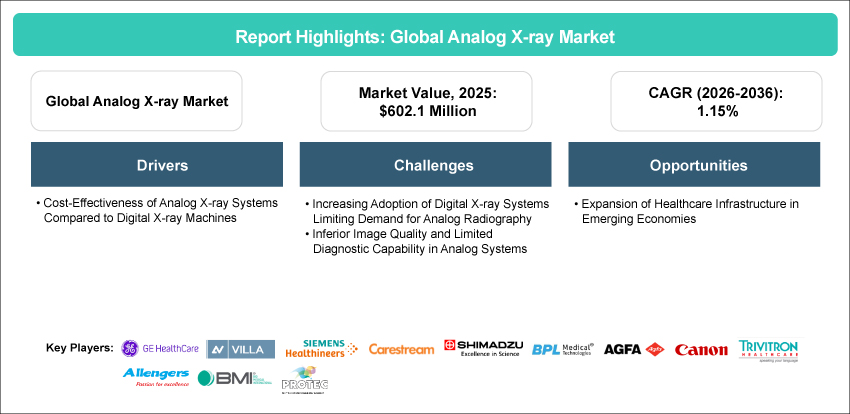
The global analog X-ray market, initially valued at $602.1 million in 2025, is projected to grow substantially, reaching $686.5 million by 2036, with a remarkable compound annual growth rate (CAGR) of 1.15% from 2026 to 2036.
The global analog X-ray market is experiencing moderate growth, driven by continued demand for affordable, easy-to-maintain radiography systems in cost-sensitive healthcare settings. Analog X-ray systems remain relevant across hospitals, diagnostic imaging centers, orthopedic clinics, dental facilities, rural healthcare centers, and public-sector providers for routine chest, orthopedic, trauma, dental, and general radiography applications. As healthcare systems gradually shift toward digital imaging, analog X-ray continues to serve as a practical bridge for facilities where full adoption of digital radiography is not immediately feasible. The market growth has been supported by demand for fixed and mobile analog X-ray systems, digital-ready platforms, durable components, and service-friendly designs that help extend the usability of existing X-ray infrastructure. However, increasing adoption of direct digital radiography is creating replacement pressure, particularly in high-volume hospitals and advanced diagnostic centers. Despite this, demand from smaller hospitals, rural facilities, mobile diagnostic units, and emerging markets is expected to support the continued use of Analog X-ray systems as an affordable option for essential diagnostic imaging.
Market Introduction
The global analog X-ray market has undergone a gradual transition as healthcare providers balance the need for affordable diagnostic imaging with the broader shift toward digital radiography. Analog X-ray systems continue to remain relevant in cost-sensitive and infrastructure-limited healthcare settings, where lower upfront cost, operational simplicity, and easier maintenance remain important purchasing factors. These systems are widely used across hospitals, diagnostic imaging centers, orthopedic clinics, dental facilities, rural healthcare centers, and public-sector providers for routine chest, orthopedic, trauma, dental, and general radiography applications.
The market is increasingly shaped by the emergence of digital-ready analog systems that allow healthcare facilities to modernize imaging workflows in phases. Many providers continue to use existing X-ray rooms and generators while preparing for future migration toward computed radiography or direct digital radiography. This phased upgrade approach is particularly important in emerging markets and smaller healthcare facilities where full digital replacement may not be financially feasible.
Companies operating in the market are focusing on reliable fixed and mobile analog X-ray platforms, compact system designs, durable components, easier servicing, and compatibility with future digital conversion pathways. While direct digital radiography adoption is increasing across high-throughput hospitals due to faster image access, improved workflow efficiency, and PACS connectivity, analog X-ray systems are expected to retain demand in selected markets. Their continued relevance will be supported by replacement demand, first-time installations, rural diagnostic expansion, and the need for affordable radiography solutions in underserved healthcare environments.
Industrial Impact
The global analog X-ray market has witnessed steady adoption, driven by the continued demand for affordable, reliable, and easy-to-maintain radiography systems across cost-sensitive healthcare settings. Key players such as Carestream Health, Shimadzu Corporation, Canon Inc., GE HealthCare, BPL Medical Technologies, PROTEC X-ray Systems GmbH, Allengers Medical Systems, and Trivitron Healthcare play an important role in supporting routine diagnostic imaging through fixed and mobile analog X-ray systems.
These systems are widely used across chest imaging, orthopedic imaging, dental radiography, trauma assessment, and general radiography applications, particularly in hospitals, diagnostic imaging centers, orthopedic clinics, rural facilities, and public-sector healthcare settings. By offering lower upfront costs, simpler servicing, and compatibility with basic radiography workflows, Analog X-ray systems continue to support access to essential diagnostic imaging.
The market’s impact is most visible in emerging economies and infrastructure-limited healthcare environments, where affordability and operational simplicity remain key procurement priorities. However, increasing adoption of digital radiography continues to create replacement pressure, especially in high-volume hospitals and advanced diagnostic centers.
Market Segmentation
Segmentation 1: By Product Type
• Fixed Analog X-ray Systems
• Mobile Analog X-ray Systems
Fixed Analog X-ray Systems Segment to Dominate the Analog X-ray Market (by Product Type)
In 2025, fixed analog X-ray systems accounted for the largest market share due to their extensive utilization across hospitals, diagnostic imaging centers, orthopedic clinics, and public healthcare institutions. These systems are widely preferred for routine high-volume imaging procedures and are suitable for chest, skeletal, abdominal, and trauma-related examinations.
Segmentation 2: By Application
• Orthopedic Imaging
• Chest Imaging
• Dental Imaging
• Others
Chest Imaging Segment to Dominate the Analog X-ray Market (by Application)
In terms of application, the chest imaging segment is expected to lead the analog X-ray market, accounting for a significant share due to the high volume of a large number of chest X-ray procedures conducted for respiratory disease diagnosis, tuberculosis screening, cardiopulmonary assessments, and routine medical evaluations. Orthopedic imaging is anticipated to register the fastest growth, driven by increasing trauma incidents, fracture diagnosis requirements, musculoskeletal disorders, and growing demand for bone and joint imaging procedures. Moreover, as chest X-rays are frequently repeated for diagnosis, follow-up, and pre-operative evaluation, healthcare facilities continue to rely on CR systems where affordability, existing X-ray infrastructure utilization, and workflow digitization are key priorities.
Segmentation 3: By End User
• Hospitals
• Orthopedic and Specialty Clinics
• Diagnostic Imaging Centers
• Other End Users
Hospitals to Dominate the Analog X-ray Market (by End User)
In terms of end user, the hospitals segment is expected to lead the analog X-ray market, supported by the high volume of routine and emergency imaging procedures performed across multiple hospital departments. Hospitals use analog X-ray systems for chest imaging, orthopedic imaging, trauma assessment, inpatient examinations, outpatient diagnostics, and pre-surgical evaluation, where affordable and reliable radiography remains essential. The segment’s dominance is driven by the wide installed base of fixed analog X-ray systems, recurring demand for basic diagnostic imaging, and the need for cost-effective equipment in public and budget-constrained hospitals. Analog X-ray systems continue to support hospital imaging workflows due to their lower upfront cost, simpler maintenance, and suitability for facilities where full digital radiography replacement is not immediately feasible.
Segmentation 4: By Region
• North America
o U.S.
o Canada
• Europe
o U.K.
o Germany
o France
o Italy
o Spain
o Rest-of-Europe
• Asia-Pacific
o China
o Japan
o India
o Australia
o South Korea
o Rest-of-Asia-Pacific
• Latin America
o Brazil
o Mexico
o Rest-of-Latin America
• Middle East and Africa
o K.S.A.
o U.A.E.
o Rest-of-Middle East and Africa
Asia-Pacific to Dominate the Analog X-ray Market (by Region)
In terms of region, Asia-Pacific is expected to lead the analog X-ray market, accounting for a significant share due to the continued demand for affordable radiography digitization across cost-sensitive and infrastructure-developing healthcare systems. The region includes a large base of hospitals, diagnostic imaging centers, dental clinics, orthopedic practices, rural healthcare facilities, and public-sector providers that continue to rely on existing X-ray infrastructure. Analog X-ray offers these facilities a practical route to transition from film-based workflows to digital image capture, storage, sharing, and reporting without the higher upfront investment required for direct digital radiography systems. The segment is further supported by hospital infrastructure expansion, rural diagnostic access initiatives, growing volumes of imaging procedures, and the need to improve PACS-compatible workflow efficiency. As healthcare providers across emerging Asia-Pacific markets continue to prioritize phased modernization, affordability, compact deployment, and reduced dependence on film processing, analog X-ray is expected to maintain a strong position in the regional market.
Recent Developments in the Analog X-ray Market
• In July 2025, Reinsberg Group completed the acquisition of PROTEC, a German developer and manufacturer of X-ray systems. Reinsberg described the transaction as a strategic move to strengthen its European medical technology portfolio and expand into advanced imaging solutions. PROTEC also confirmed that, from July 1, 2025, it became part of the Reinsberg Group and changed its legal form to PROTEC X-ray Systems GmbH.
• In July 2025, Carestream Health announced a partnership with Vietnam South East Asia Joint Stock Company (VISTACOM), a distributor of advanced medical equipment solutions in Vietnam, to expand distribution of its medical imaging portfolio, including X-ray systems and DR detectors.
Demand – Drivers, Challenges, and Opportunities
Market Drivers
Cost-effectiveness of Analog X-ray Systems Compared to Digital X-ray Machines: Cost-effectiveness remains a key driver for the analog X-ray market, particularly in price-sensitive and infrastructure-limited healthcare settings. Many small hospitals, primary health centers, standalone diagnostic clinics, and rural facilities continue to prioritize basic imaging access over advanced digital workflow integration. Analog X-ray systems are preferred in these settings due to their lower upfront cost, simpler installation, and easier maintenance compared to digital radiography systems. This makes them suitable for facilities with limited capital budgets and low-to-moderate imaging volumes. In emerging markets, providers may choose analog systems to expand diagnostic access across multiple locations rather than invest in fewer high-cost digital systems. Their lower infrastructure dependency also reduces the need for PACS integration, detector lifecycle management, and advanced IT support. As a result, analog systems continue to serve as practical entry-level imaging solutions in cost-constrained healthcare environments.
Market Challenges
Increasing Adoption of Digital X-ray Systems Limiting Demand for Analog Radiography: The growing adoption of digital radiography is a major challenge for the analog X-ray market. Digital X-ray systems offer faster image availability, improved workflow efficiency, better image quality, electronic storage, PACS/RIS connectivity, and stronger compatibility with AI-enabled imaging workflows. These advantages make digital systems more attractive for high-volume hospitals, advanced diagnostic centers, trauma units, and modern healthcare networks. In comparison, analog systems face limitations related to slower image processing, manual handling, limited interoperability, and weaker integration with digital health infrastructure. As healthcare providers increasingly prioritize speed, scalability, and connected imaging workflows, capital investments are shifting toward digital radiography. This trend is gradually reducing the demand for analog systems, especially in developed and urban healthcare markets. Consequently, analog X-ray systems are becoming more limited to low-resource, low-volume, and infrastructure-constrained settings.
Market Opportunities
Expansion of Healthcare Infrastructure in Emerging Economies: The expansion of healthcare infrastructure in emerging economies presents a key opportunity for the analog X-ray market. Many countries across Asia, Africa, Latin America, and the Middle East are investing in district hospitals, primary care centers, rural clinics, and public diagnostic facilities to improve access to basic healthcare services. In these settings, affordability, serviceability, and rapid deployment are often prioritized over advanced digital integration. Analog X-ray systems remain suitable because they require lower upfront investment, simpler maintenance, and less IT infrastructure than digital radiography systems. They can support essential applications such as chest imaging, trauma assessment, orthopedic imaging, dental radiography, and routine diagnostic examinations. As governments and private providers continue expanding frontline diagnostic capacity, analog systems are expected to remain relevant as entry-level imaging solutions. This creates opportunities for vendors offering durable, low-cost systems with strong local service and distribution support.
Analyst’s Thoughts
According to Priyanshi Upadhyay, Research Analyst - BIS Research, “The analog X-ray market is expected to witness moderate growth, supported by the continued need for affordable and reliable radiography systems across cost-sensitive healthcare settings. While digital radiography is becoming the preferred choice in high-volume hospitals and advanced diagnostic centers due to faster image access, improved workflow efficiency, and better image quality, analog X-ray systems continue to remain relevant in smaller hospitals, diagnostic centers, rural facilities, orthopedic clinics, and public-sector healthcare settings. Their lower upfront cost, simpler maintenance, and suitability for basic chest, orthopedic, trauma, dental, and general radiography applications make them practical for facilities with limited capital budgets and infrastructure. Going forward, market opportunities are expected to remain concentrated in emerging economies and low-resource healthcare environments, where affordability, service support, durability, and ease of deployment will be more important than advanced digital integration.”
Analog X-ray Market - A Global and Regional Analysis
Focus on Product Type, Application, End User, and Region - Analysis and Forecast, 2026-2036
Frequently Asked Questions
Ans: Analog X-ray is a conventional radiography technology that uses X-ray film or compatible imaging systems to capture diagnostic images for applications such as chest imaging, orthopedic imaging, trauma assessment, dental radiography, and general radiography. These systems remain relevant in cost-sensitive healthcare settings due to their lower upfront cost, simpler maintenance, and suitability for basic diagnostic imaging needs.
Ans: To strengthen their market position, companies are focusing on affordable fixed and mobile analog X-ray systems, durable system design, ease of servicing, regional distribution, and support for cost-sensitive healthcare providers. Many players are targeting smaller hospitals, diagnostic centers, orthopedic clinics, rural facilities, and public-sector healthcare settings where affordability, basic imaging access, and simple installation remain key purchasing priorities. Service support, local availability, product reliability, and upgrade pathways toward digital imaging are also becoming important competitive strategies.
Ans: The following are the USPs of this report:
• Market regulations and key trends in the analog X-ray market
• Market dynamic analysis of the opportunities, trends, and challenges in the market
Ans: This report is valuable for analog X-ray system manufacturers, medical imaging equipment companies, distributors, hospitals, diagnostic imaging centers, orthopedic and specialty clinics, public-sector healthcare providers, service providers, and investors involved in radiography infrastructure and basic diagnostic imaging solutions.